What Is VoLTE? Calls, Data & IMS Rules
Voice over LTE (VoLTE) routes calls and SMS over 4G LTE via IMS. Learn why turning it off breaks calls after 3G shutdowns and how to check IMS status.
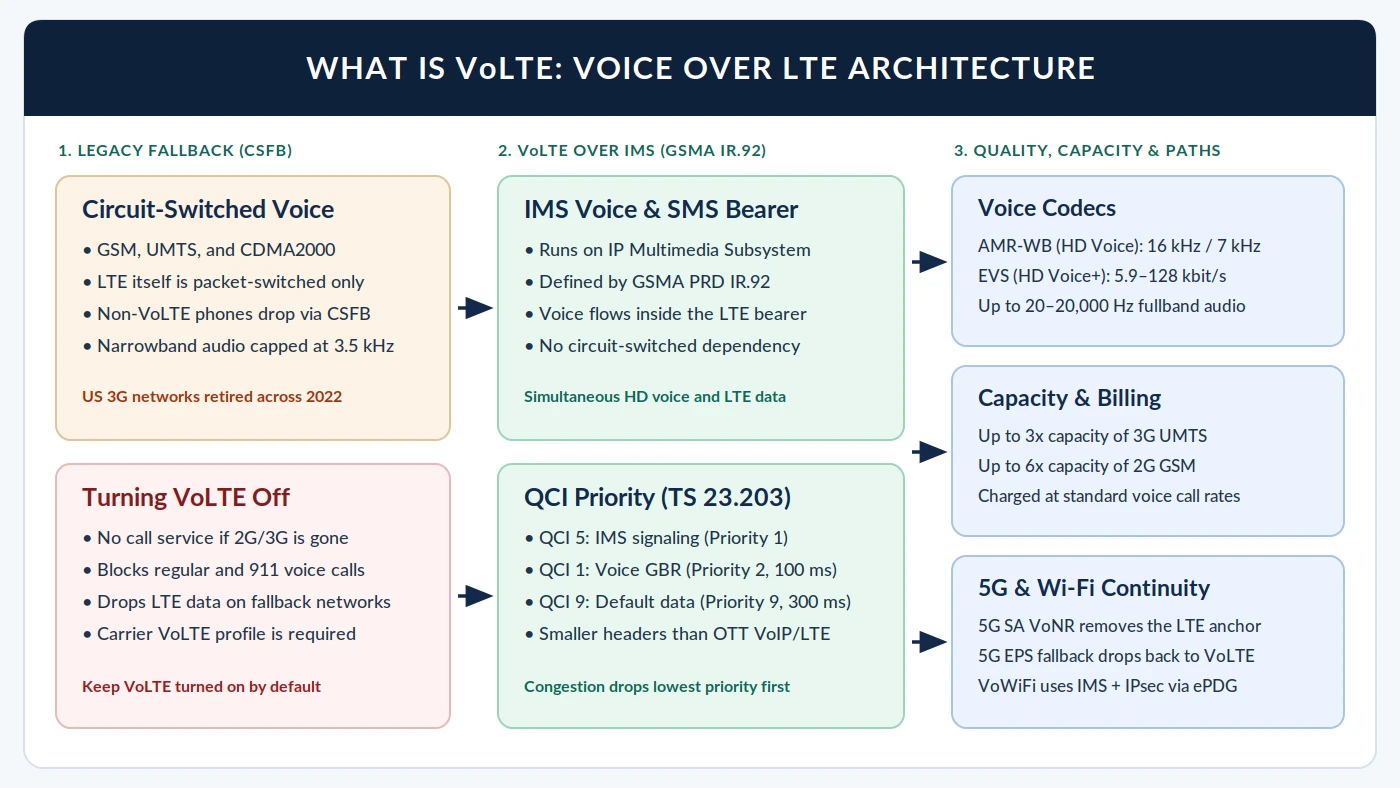
Voice over LTE (VoLTE) is the all-IP cellular standard that routes regular phone calls and SMS over a 4G LTE network through the IP Multimedia Subsystem (IMS) rather than legacy 2G or 3G voice channels. Keep VoLTE turned on: after 3G network shutdowns, disabling VoLTE can block calls, texts, and 911 access while interrupting mobile data.
Unlocked and imported smartphones frequently show full 4G LTE bars and working mobile data while outgoing and incoming voice calls fail immediately. That symptom traces directly to how LTE handles voice, how carrier-specific VoLTE profiles register with IMS, and what happens once legacy 3G networks shut down. For broader SIM, APN, and line diagnostics, start with our SIM plans and mobile troubleshooting hub.
Should you leave VoLTE turned on or off on your smartphone?
Yes—leave VoLTE turned on by default on every modern smartphone. Because major US carriers retired their 3G networks in 2022, turning VoLTE off removes the IP calling path on LTE-only coverage, leaving phones unable to place or receive calls, including 911 calls, while also sacrificing up to three times the capacity of 3G UMTS.
As explained in the FCC 3G network phase-out consumer guide, mobile carriers shut down older 3G networks to free up spectrum and infrastructure for newer services including 5G. Once 3G towers go offline, both 3G handsets and older 4G phones that do not support Voice over LTE (VoLTE or HD Voice) lose voice, text, 911 calling, and data service. That same requirement extends to prepaid brands and mobile virtual network operators—including Cricket, Boost, Straight Talk, and several Lifeline providers—because they operate over AT&T, Verizon, and T-Mobile host networks.
| US host network | Legacy voice network retired | Shutdown milestone | Impact on non-VoLTE phones |
|---|---|---|---|
| AT&T | 3G UMTS | Phased out beginning February 2022 | Calls, texts, and 911 require VoLTE |
| Sprint (via T-Mobile) | 3G CDMA and Sprint 4G LTE | 3G CDMA March 31, 2022; 4G LTE June 30, 2022 | Legacy CDMA and non-VoLTE devices lose service |
| T-Mobile | 3G UMTS | Shut down July 1, 2022 | Voice relies on VoLTE or 5G where legacy layers are absent |
| Verizon | 3G CDMA | Shut down completed December 31, 2022 | Devices must support LTE with VoLTE or 5G |
Even before Verizon completed its CDMA shutdown on December 31, 2022, handsets built without CDMA radios—starting with the Pixel 6 and iPhone 14 series, along with select older GSM-carrier models—operated on Verizon exclusively in VoLTE mode. Leaving VoLTE enabled is therefore no longer an optional audio enhancement; it is the baseline requirement for voice service on modern cellular networks. For historical carrier band and IMEI admission rules after these shutdowns, see our breakdown of GSM versus CDMA unlocked phone compatibility.
What happens to calls and mobile data if you turn off VoLTE?
Turning off VoLTE forces a 4G LTE phone to rely on circuit-switched fallback (CSFB) to a 2G or 3G network for every voice call. Where legacy 2G and 3G voice networks have been shut down, disabling VoLTE leaves the phone with no call service at all; where a legacy network still operates, calls drop off LTE for the entire conversation.
The root cause is architectural. Unlike GSM, UMTS, and CDMA2000, all of which carried voice over dedicated circuit-switched channels, the LTE standard supports only packet switching across an all-IP network. Early LTE deployments lacked universal VoLTE software and core infrastructure, so operators adopted circuit-switched fallback as a temporary bridge. Whenever a non-VoLTE handset placed or received a call, its radio dropped from LTE down to 2G or 3G for the duration of the call, interrupting high-speed LTE data sessions until the call ended.
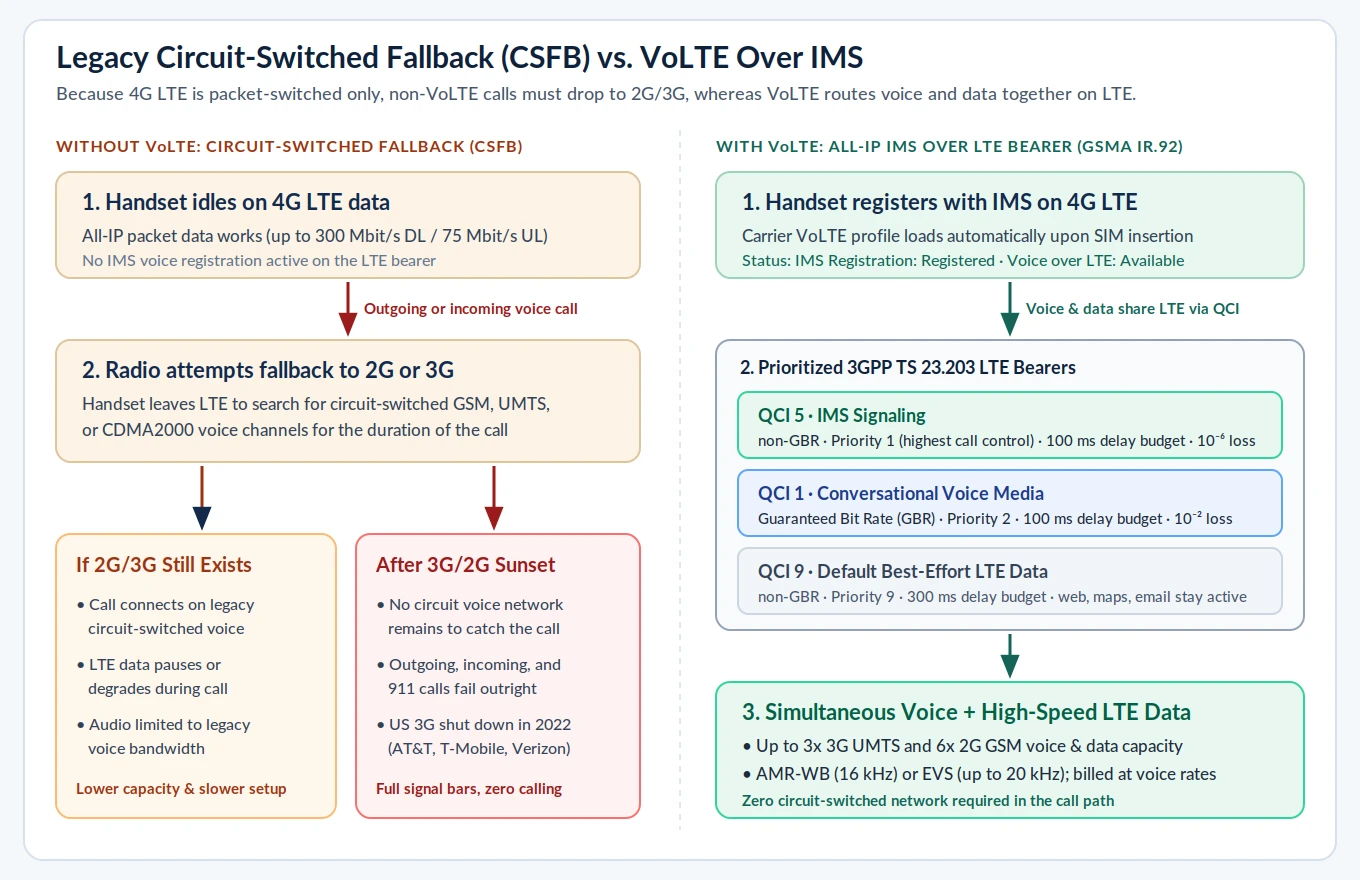
With VoLTE active, both the control plane and the voice media plane travel as IP data flows inside the LTE bearer, removing any dependency on a circuit-switched voice network in the call path. You can browse, pull up navigation maps, or download attachments on LTE at the same time you speak. On dual-SIM handsets, active calling behavior also interacts with single-radio standby rules, covered separately in our guide to dual-SIM DSDS versus DSDA radio modes.
What is the difference between standard LTE data and VoLTE?
Standard LTE is an all-IP packet-switched data radio providing peak rates up to 300 Mbit/s downlink, 75 Mbit/s uplink, and less than 5 ms radio-access latency without native circuit voice. VoLTE layers the IP Multimedia Subsystem (IMS) voice profile defined by GSMA PRD IR.92 onto LTE, assigning voice signaling and speech packets prioritized Quality of Service bearers instead of best-effort data queues.
How IMS and 3GPP QCI bearers separate voice from web traffic
A common misconception is that VoLTE is simply an ordinary internet voice app running over standard LTE data. In reality, 3GPP TS 23.203 QoS Class Identifiers (QCI) divide LTE traffic into standardized classes with distinct resource guarantees, scheduling priorities, packet delay budgets, and error-loss ceilings edge-to-edge between the phone and the Packet Data Network Gateway. Nine QCI values were standardized in Release 8, expanding to 13 in Release 12 and 15 in Release 14.
| LTE traffic class | QCI value | Resource type | Priority level | Packet delay budget | Packet error loss rate | Typical traffic role |
|---|---|---|---|---|---|---|
| IMS signaling | QCI 5 | non-GBR | 1 | 100 ms | 10⁻⁶ | IMS call signaling and control |
| Conversational voice | QCI 1 | Guaranteed Bit Rate (GBR) | 2 | 100 ms | 10⁻² | Live conversational voice media |
| Default LTE data | QCI 9 | non-GBR | 9 | 300 ms | 10⁻⁶ | Default web, email, chat, and buffered video |
Every QCI carries a numeric priority level where 0.5 is the highest priority class. When an LTE cell sector becomes congested, traffic with the lowest priority level (the highest priority number, such as default QCI 9 data) is discarded first, protecting QCI 5 IMS call signaling and QCI 1 Guaranteed Bit Rate voice packets from stalling behind heavy downloads.
Voice codecs from narrowband to HD Voice and EVS
VoLTE also upgrades speech encoding, though turning VoLTE on does not automatically guarantee top audio clarity on every call, as examined in peer-reviewed cellular voice quality evaluations on NIH PMC. Under 3GPP rules, 3GPP demands at least the narrowband AMR-NB codec for compatibility, while recommending Adaptive Multi-Rate Wideband (AMR-WB)—certified by the GSMA as HD Voice—for 3GPP networks capable of 16 kHz sampling. Many modern carriers and devices add Enhanced Voice Services (EVS), specified in 3GPP TS 26.441 and branded as HD Voice+ (or HD+ on Samsung handsets), with 3GPP EVS channel-aware coding and EVS packet-loss concealment improving robustness against cellular delay jitter and frame loss.
| Voice codec tier | Commercial label | Audio frequency range | Input sampling rates | Bitrate range | Key technical behavior |
|---|---|---|---|---|---|
| AMR-NB | Narrowband voice | Up to 3.5 kHz | Narrowband baseline | 3GPP compatibility baseline | Minimum 3GPP compatibility codec |
| AMR-WB | HD Voice | Up to 7 kHz | 16 kHz mandated in 3GPP | AMR-WB+ 5.2 to 48 kbit/s | Recommended VoLTE codec; also used on 3G |
| EVS (3GPP TS 26.441) | HD Voice+ / Full-HD Voice | Superwideband 20–16,000 Hz or fullband 20–20,000 Hz | 8, 16, 32, and 48 kHz | 5.9 to 128 kbit/s | Switches bitrates every 20 ms; channel-aware coding and packet loss concealment |
Two caveats explain why some VoLTE calls still sound flat. First, EVS spans a wide bitrate range from 5.9 kbit/s to 128 kbit/s, allowing carriers to prioritize cell capacity over maximum audio fidelity. Second, end-to-end HD Voice or EVS requires both calling devices, both mobile operators, and the inter-carrier interconnect to support the codec; by default, many cross-carrier interconnects route voice over narrowband links, downgrading audio quality even while both handsets remain connected on VoLTE or VoNR.
Is VoLTE calling free or does it count against your monthly data plan?
VoLTE calls are usually charged at the same rate as standard cellular voice calls rather than billed as an extra add-on feature. Even though VoLTE delivers speech packets over the LTE radio bearer, operators separate IMS voice sessions from regular internet data traffic, and VoLTE’s smaller packet headers consume less bandwidth than unoptimized VoIP apps running over LTE.
From a network engineering standpoint, carriers incentivize keeping VoLTE enabled because packetized IMS voice uses spectrum far more efficiently than legacy circuit-switched channels. VoLTE delivers up to three times the voice and data capacity of older 3G UMTS and up to six times more capacity than 2G GSM. Because smaller VoLTE packet headers trim overhead compared with unoptimized over-the-top VoIP on LTE, carriers can carry far more concurrent conversations on the same frequency bands while billing those minutes under your plan’s normal voice-calling terms.
How does VoLTE compare with 5G VoNR and Wi-Fi Calling?
VoLTE serves as the cellular IMS voice anchor alongside two companion IP calling standards: 5G Voice over New Radio (VoNR) and Wi-Fi Calling (VoWiFi). VoNR keeps calls entirely inside a 5G Standalone network without dropping to LTE, while Wi-Fi Calling tunnels native carrier IMS calls over broadband Wi-Fi through an IPsec gateway with seamless handover back to VoLTE.
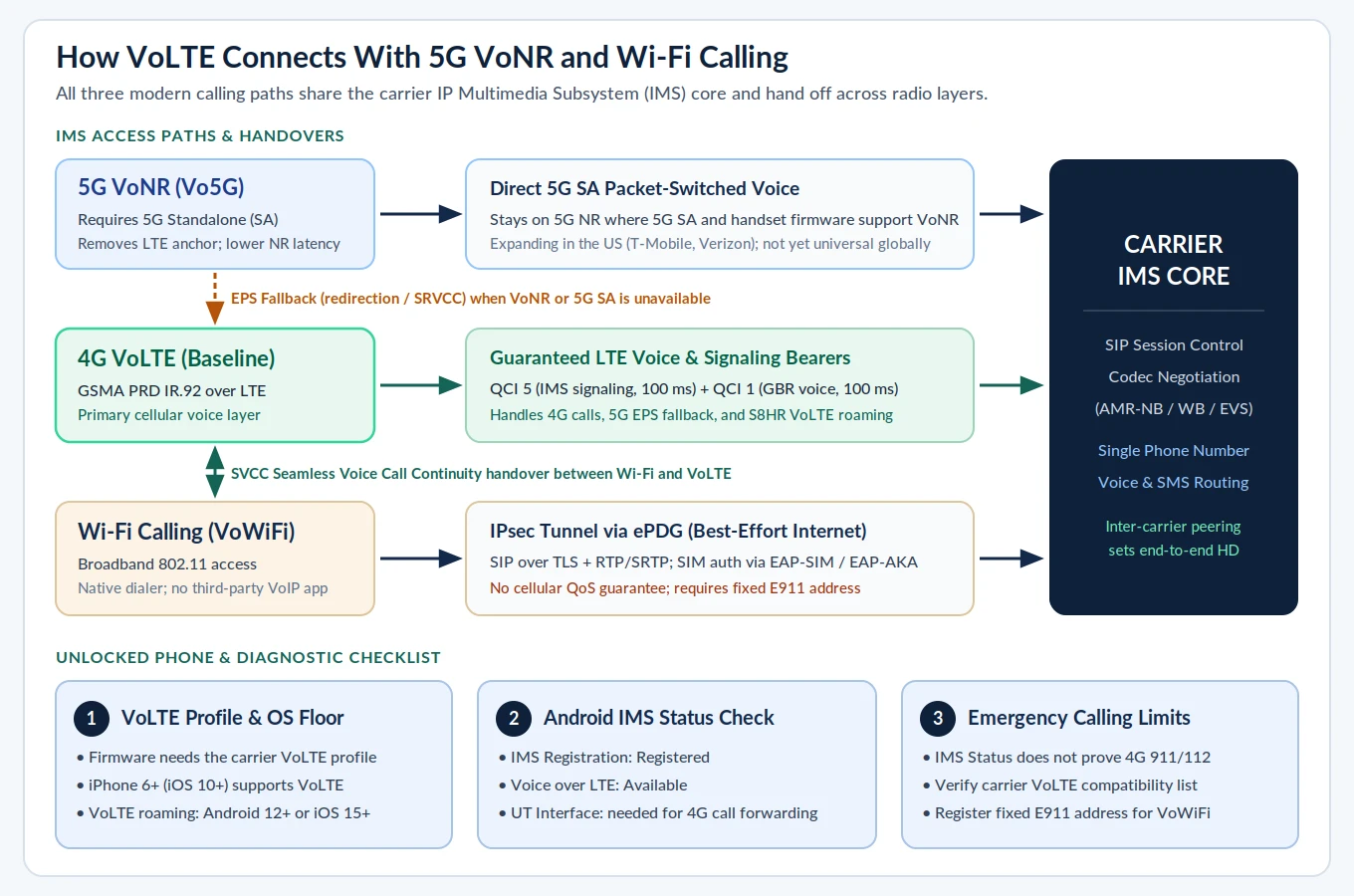
As documented in Voice over NR architecture specifications, 5G, just like 4G LTE, does not natively carry circuit-switched voice. VoNR (also called Vo5G or Vo5GSA) eliminates the LTE anchor and takes advantage of 5G NR’s lower latency for faster call setup, but it requires a 5G Standalone (SA) network, compatible handset firmware, and local carrier support. As of 2025, 5G Standalone and VoNR are still not widely available globally even as US operators such as T-Mobile and Verizon expand nationwide 5G SA and VoNR access. Wherever VoNR is unavailable or unsupported by the handset, 5G networks trigger Evolved Packet System (EPS) fallback—redirecting the phone or handing the call over via Single Radio Voice Call Continuity (SRVCC) to 4G VoLTE so the call does not drop, at the cost of higher setup latency. (For 5G band labels and battery behavior on US carriers, see our guide to 5G UW versus 5G UC frequency bands and battery drain.)
Wi-Fi Calling (VoWiFi) extends the same IMS baseline over home or office wireless LANs using IPsec tunneling to an Evolved Packet Data Gateway (ePDG), SIP over TLS for call control, RTP/SRTP for voice media, and SIM-based EAP-SIM or EAP-AKA authentication. Unlike closed third-party VoIP apps, VoWiFi uses your phone’s native dialer and carrier phone number and supports Seamless Voice Call Continuity (SVCC) handovers to and from VoLTE. However, Wi-Fi Calling runs over best-effort broadband connections with no end-to-end cellular QoS guarantees, and because it cannot rely on cellular GPS or Assisted GPS for E911 routing, carriers require registering a fixed primary address in phone settings or the carrier portal.
| Calling standard | Radio access path | Core network & tunnel | QoS guarantee | Handover & fallback path | Emergency routing requirement |
|---|---|---|---|---|---|
| VoLTE | 4G LTE cellular | Carrier IMS (GSMA PRD IR.92) | Standardized QCI 5 & QCI 1 GBR | SRVCC handover where 2G/3G remains; SVCC with VoWiFi | Carrier 4G emergency calling config required |
| 5G VoNR (Vo5G) | 5G Standalone (SA) NR | Carrier IMS over 5G SA | Packet-switched 5G NR low-latency voice | EPS fallback (redirection or SRVCC) to 4G VoLTE | Carrier 5G/4G IMS emergency routing |
| Wi-Fi Calling (VoWiFi) | Wi-Fi wireless LAN broadband | Carrier IMS via IPsec & ePDG | None (best-effort home/public Internet) | SVCC seamless handover to and from VoLTE | Registered fixed primary address for E911 |
How do you enable and verify VoLTE on Android and iPhone?
Most modern phones enable VoLTE automatically as soon as you insert a SIM card whose operator VoLTE profile is present in the device firmware. If VoLTE does not activate—common on imported or carrier-flashed unlocked handsets—install pending OS and carrier updates, confirm carrier profile compatibility, and verify IMS Registration directly in Android diagnostics.
Carrier VoLTE profiles, unlocked phones, and OS minimums
Unlike 2G and 3G voice calling, there is no single universal VoLTE configuration supported identically across every carrier and handset worldwide. Operators rely on carrier-specific VoLTE profiles distributed through manufacturer firmware updates, while some networks also accept the GSMA IR.92 Open Market Device configuration designed for non-carrier unlocked handsets. Although Qualcomm Snapdragon chipsets have supported VoLTE in hardware since at least 2014 (including the Snapdragon 800 and 801), some Android vendors disabled VoLTE in software or omitted specific carrier modem configurations—creating a major gap between factory-unlocked and carrier-branded variants detailed in our comparison of unlocked versus carrier phones.
On Apple hardware, the iPhone 6 (2014) and newer running at least iOS 10 support VoLTE calling on most networks, whereas the older iPhone 5 and 5s include LTE data radios without VoLTE voice capability. When purchasing a phone independently of a carrier, the FCC recommends checking VoLTE (HD Voice) compatibility in the phone’s settings, user manual, or model-number specifications and installing any required software update before assuming the hardware is incompatible.
Checking Android IMS Status, UT Interface, roaming, and 911 limits
On Android smartphones, you can verify live IMS provisioning without guessing from status-bar icons by inspecting the Device IMS Status screen inside Android’s hidden Radio Info Debug menu:
| Verification item | Working VoLTE state | Failure or limitation indicator | Practical meaning for the user |
|---|---|---|---|
| IMS Registration | Registered | Not Registered | Confirms the SIM and carrier modem profile authenticated with IMS |
| Voice over LTE | Available | Unavailable | Confirms firmware provisioning and carrier modem config are active |
| UT Interface | Available | Unavailable | Not needed for voice calls, but required to edit Call Forwarding or Call Busy on 4G LTE only networks |
| VoLTE Roaming (S8HR) | Android 12 (2021)+ or iOS 15 (2021)+ | Older OS (Android 4–11) | Needed to place VoLTE calls while roaming on foreign LTE networks where 2G/3G are retired |
| 4G Emergency Calling (911/112) | Verified on carrier compatibility list | IMS Registered alone is NOT proof | A phone with working regular VoLTE can still fail 911/112 over 4G if emergency IMS is disabled |
Two real-world deployment findings show why checking beyond basic LTE signal bars matters. First, international VoLTE roaming uses the S8HR architecture and requires Android 12 (2021) or newer or an iPhone running iOS 15 (2021) or newer; as of April 2023, Android 4 through 11 still represented roughly 70% of the global Android device market according to Google, leaving many older phones unable to place voice calls when roaming into countries without 2G or 3G networks. Second, active IMS Registration in Android’s debug screen does not prove that 4G emergency calling works: prior to Australia’s 2024 3G switch-off, an initial federal government warning flagged more than 740,000 4G VoLTE phones (cited as over 1 million in media reports) as potentially unable to reach emergency services without 3G, before a completed technical review narrowed the affected count to fewer than 70,000 devices. Confirming your exact model on your carrier’s compatibility list—and updating firmware before traveling or switching SIMs—prevents silent voice and emergency-calling failures.
Frequently asked questions about VoLTE calling
What does the VoLTE icon mean at the top of my phone screen?
The VoLTE icon means your smartphone has loaded a compatible carrier VoLTE profile, completed IMS registration on the 4G LTE network, and is ready to route voice calls and SMS over the LTE data bearer without dropping down to 2G or 3G.
Why do my calls fail even though I have full 4G LTE bars and working mobile data?
Standard LTE carries packet-switched data only, so full LTE bars do not guarantee voice calling. If VoLTE is turned off, blocked by a missing carrier modem profile, or unregistered with IMS—and your carrier has shut down 3G networks—mobile data continues working while voice calls fail.
Does VoLTE work while roaming internationally?
Yes, if your handset and carrier support VoLTE Roaming via the S8HR architecture, which requires Android 12 or newer or an iPhone running iOS 15 or newer. Devices lacking VoLTE Roaming support rely on 2G or 3G fallback abroad and lose calling service in countries that have retired both 2G and 3G.
Why do some VoLTE calls still sound like old narrowband phone calls?
VoLTE requires both phones, both carriers, and the inter-carrier connection between them to support AMR-WB (HD Voice) or EVS (HD Voice+). When inter-carrier links default to narrowband routing, audio quality drops to narrowband even though the call remains on VoLTE or VoNR.
Is Wi-Fi Calling the same thing as VoLTE?
No, though both share the same carrier IP Multimedia Subsystem (IMS) core and can hand calls off smoothly via SVCC. VoLTE carries voice over cellular 4G LTE with prioritized QCI 1 and QCI 5 Quality of Service, whereas Wi-Fi Calling tunnels voice over broadband Wi-Fi through IPsec and an ePDG with best-effort internet QoS and a registered fixed E911 address.
Sources
- Plan Ahead for Phase Out of 3G Cellular Networks and Service — FCC
- NIH PMC — Voice Quality Evaluation in a Mobile Cellular Network: In Situ Mean Opinion Score Measurements
- IEEE ICASSP — Improved error resilience for VoLTE and VoIP with 3GPP EVS channel aware coding
- IEEE ICASSP — Packet-loss concealment technology advances in EVS
- GSMA — PRD IR.92 IMS Profile for Voice and SMS
- 3GPP — Policy and Charging Control Architecture (TS 23.203) and Enhanced Voice Services (TS 26.441)
Related technical guides
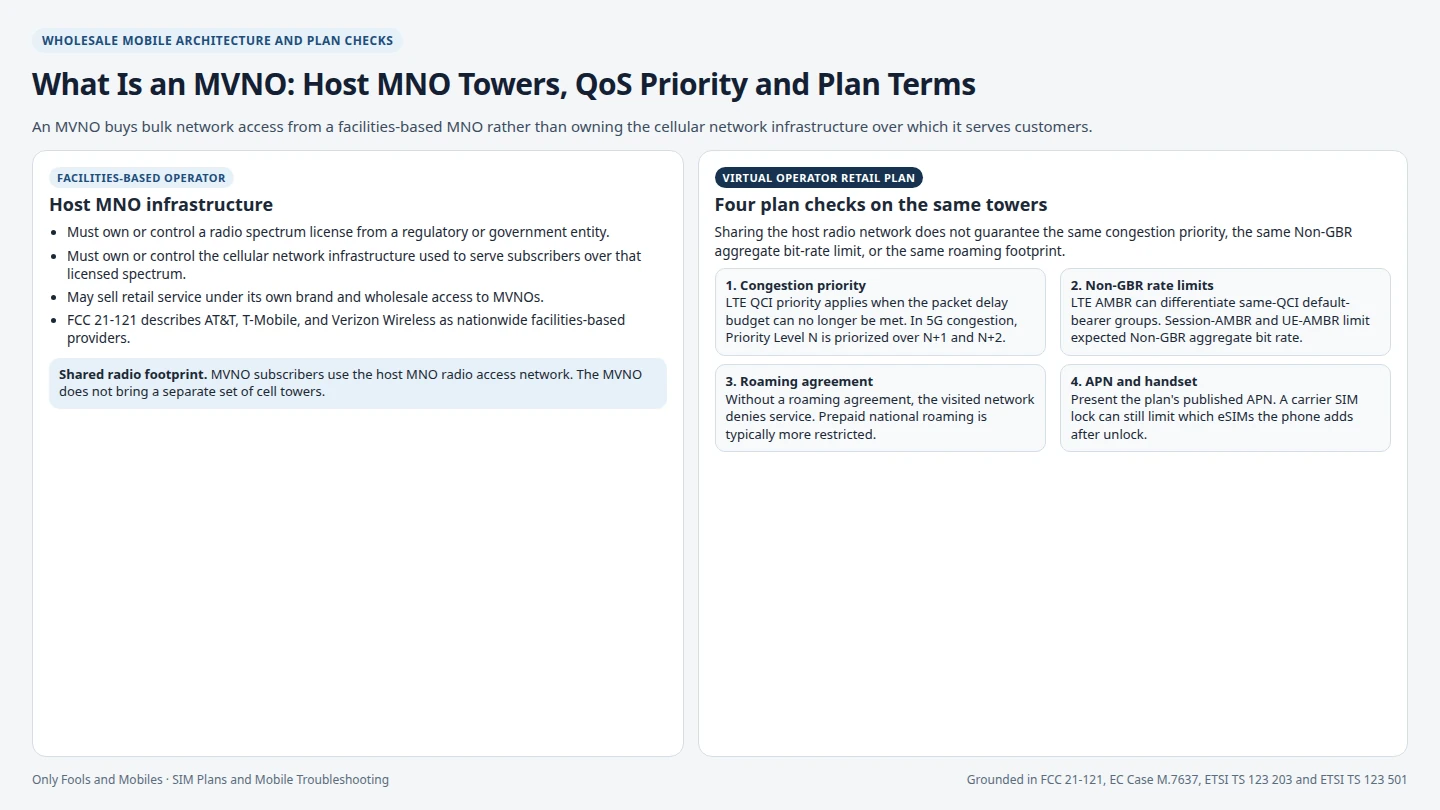
What Is an MVNO: Tower Priority and Plans
An MVNO buys wholesale access from a host MNO instead of owning towers. Plans on the same host can differ in priority, rate caps, APN, and roaming.
Read technical guide
Number Transfer PIN: Port-Out Code & Steps
A number transfer PIN is a temporary carrier code that approves wireless porting. Compare AT&T, Verizon, T-Mobile, Xfinity, and prepaid steps.
Read technical guide
Dual SIM DSDS vs DSDA Radio Modes
Compare DSDS versus DSDA Android dual SIM standby versus dual active radio behavior, second SIM call and data rules, eSIM MEP, and model checks.
Read technical guide