What Is an MVNO: Tower Priority and Plans
An MVNO buys wholesale access from a host MNO instead of owning towers. Plans on the same host can differ in priority, rate caps, APN, and roaming.
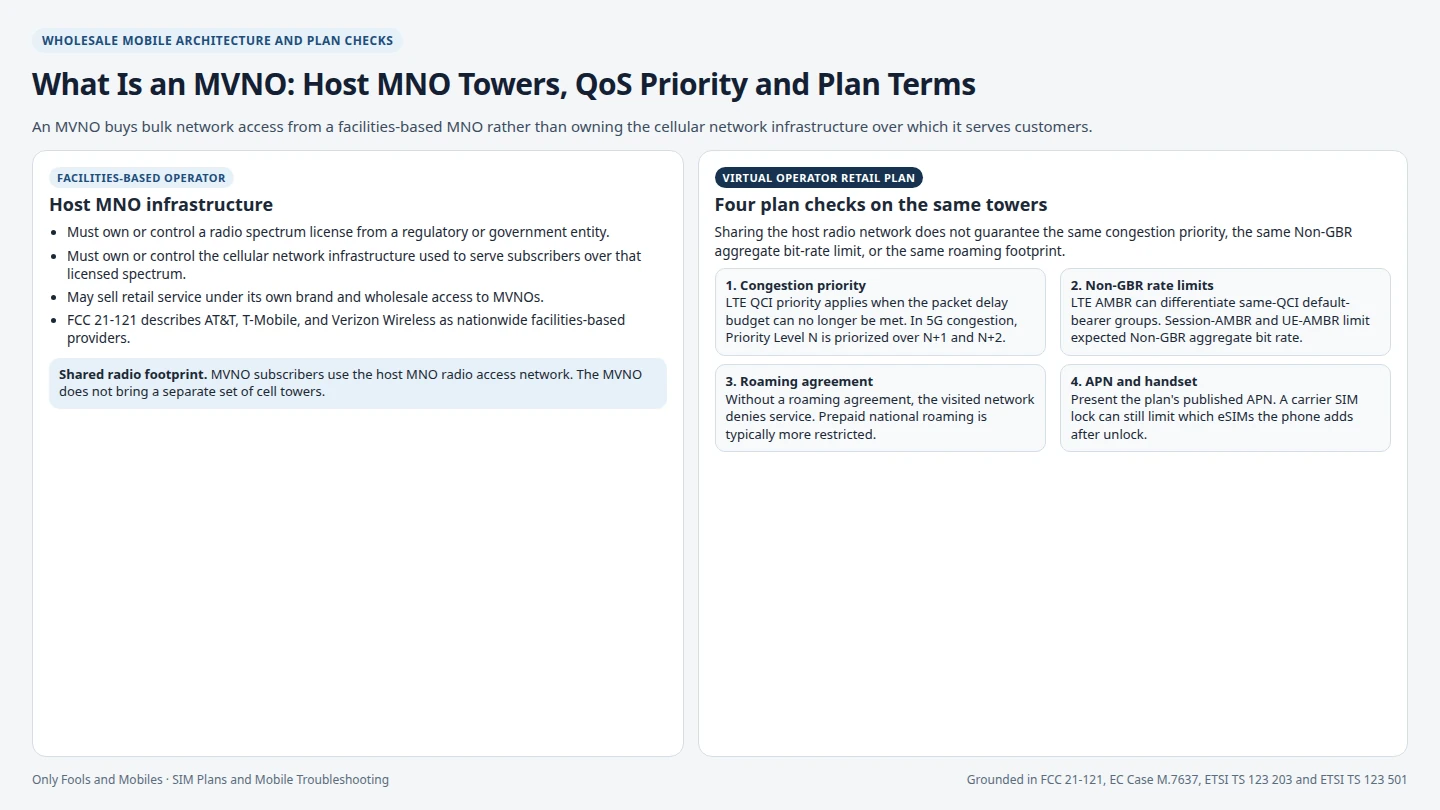
A mobile virtual network operator (MVNO) is a mobile telephony service provider that does not own the cellular network infrastructure over which it provides services to its customers. Instead, an MVNO enters into a business agreement with a mobile network operator (MNO) to obtain bulk access to network services at wholesale rates and sets retail prices independently, purchasing mobile wireless services wholesale from facilities-based service providers and reselling them. In the United States, Verizon, AT&T, and T-Mobile are the major mobile network operators, described in FCC 21-121 as “nationwide” facilities-based service providers.
Sharing the same host radio network does not guarantee the same congestion priority, the same Non-GBR aggregate bit-rate cap, or the same roaming footprint. Under European Commission Case M.7637, a full MVNO relies on a host MNO’s mobile network while owning its core infrastructure, issuing its SIM cards, and maintaining its network code, customer database, and back-office functions, whereas a light MVNO owns no core infrastructure and relies entirely on the host MNO’s infrastructure. Under ETSI TS 123 203 V19.2.0 (3GPP TS 23.203 Release 19) and ETSI TS 123 501 V18.7.0 (3GPP TS 23.501 Release 18), congestion scheduling uses LTE QCI Priority levels (applied when Packet Delay Budget targets can no longer be met) and 5G Priority Levels, while separate Aggregate Maximum Bit Rate controls differentiate LTE default-bearer subscriber groups (AMBR) and limit expected aggregate bit rates across 5G Non-GBR QoS Flows (Session-AMBR and UE-AMBR).
Two plans using the same towers can differ in data allowance, hotspot support, roaming, video limits, and congestion management; see our SIM plans and mobile troubleshooting hub when isolating a live data or calling fault. Carrier status-bar badges such as Verizon’s 5G UW and T-Mobile’s 5G UC identify carrier-branded network capabilities that can include both mid-band and millimeter-wave service rather than speed-test results or exact serving bands, as covered in 5G UW versus 5G UC frequency and battery drain. Before moving your number, verify SIM-lock and model eligibility on our unlocked versus carrier phone band support guide.
What does MVNO stand for, and how does it differ from an MNO?
MVNO stands for mobile virtual network operator: a mobile telephony service provider that does not own the cellular network infrastructure used to serve its subscribers. Both MVNOs and MNOs are mobile phone operators, and an MNO — also called a mobile network provider, wireless carrier, wireless operator, wireless telco, or cellular company — sells, delivers, and maintains mobile number services to customers.
A defining characteristic of a mobile network operator is that it must own or control access to a radio spectrum license from a regulatory or government entity, and must own or control the cellular network infrastructure elements required to serve subscribers over that licensed radio spectrum. Beyond offering retail services under its own brand, an MNO may sell wholesale access to network services to MVNOs for resale to other customers. In FCC 21-121, the Federal Communications Commission likewise states that MVNOs do not own any network facilities, instead purchasing mobile wireless services wholesale from facilities-based service providers — including the three providers described as “nationwide,” AT&T, T-Mobile, and Verizon Wireless — and reselling those services.
Is an MVNO slower than a major carrier on the same towers?
Two plans using the same towers can differ in congestion management, video limits, hotspot support, roaming, and data allowance, and network standards separate busy-cell scheduling priority from Non-GBR aggregate bit-rate caps rather than imposing a single speed penalty on every MVNO. Read the exact plan’s published network-management policy to see how both controls are configured.
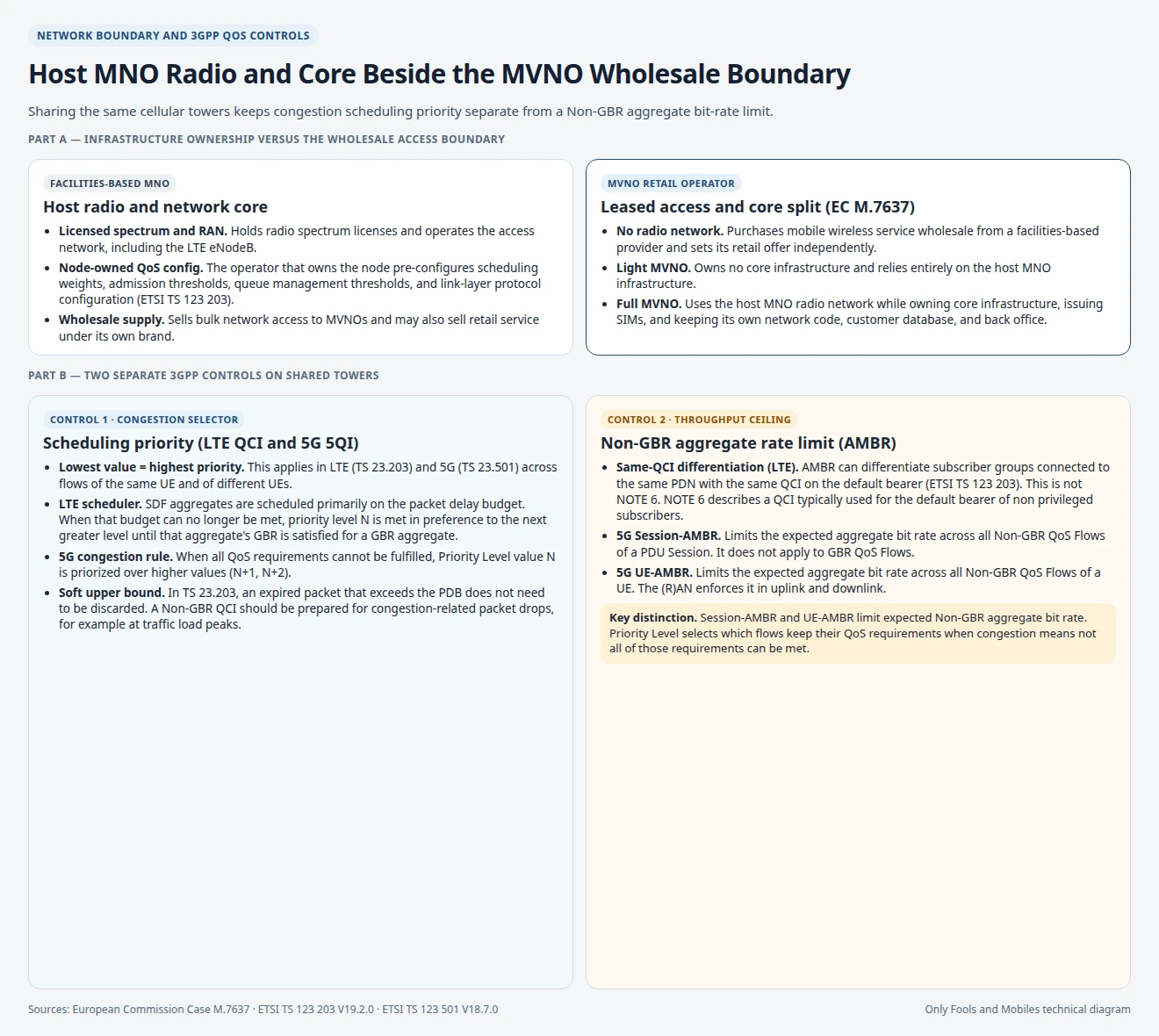
On LTE under ETSI TS 123 203 V19.2.0 (3GPP TS 23.203 Release 19), the service-level Quality of Service (QoS) parameters per Service Data Flow (SDF) or SDF aggregate are QCI, ARP, GBR, and MBR, and each SDF is associated with one and only one QoS Class Identifier (QCI). Within the LTE access network (namely the eNodeB), the QCI is a scalar referencing node-specific packet-forwarding parameters — such as scheduling weights, admission thresholds, queue management thresholds, and link-layer protocol configuration — pre-configured by the operator owning the node. Under 3GPP TS 23.203, 9 QCI values in Release 8 (13 QCIs in Release 12 and 15 QCIs in Release 14) are standardized with packet-forwarding characteristics (such as Guaranteed Bit Rate or non-Guaranteed Bit Rate, Priority Handling, Packet Delay Budget, and Packet Error Loss rate) between the UE and the PCEF (or P-GW); those standardized characteristics are not signalled on any interface and serve as pre-configuration guidelines so mapped services receive the same minimum QoS across multi-vendor networks and in roaming.
Every LTE QCI (GBR and Non-GBR) is associated with a Priority level in which the lowest Priority level value corresponds to the highest Priority, differentiating SDF aggregates of the same UE and SDF aggregates from different UEs. Under ETSI TS 123 203 V19.2.0, scheduling between different SDF aggregates is primarily based on the Packet Delay Budget (PDB), which sets an equal uplink and downlink upper bound for packet delay between the UE and the PCEF to configure scheduling priority weights and HARQ target operating points. Only when the target set by the PDB can no longer be met for one or more SDF aggregates across all UEs with sufficient radio channel quality does the scheduler use the QCI Priority level, meeting the PDB of an SDF aggregate on QCI Priority level N in preference to meeting the PDB of SDF aggregates on the next QCI Priority level greater than N, until the priority level N SDF aggregate’s GBR has been satisfied when that aggregate is a GBR SDF aggregate. Although the Wikipedia QCI summary states that Priority level 0.5 is the highest Priority level and describes congestion as discarding the lowest Priority level traffic (highest Priority number) first, ETSI TS 123 203 V19.2.0 specifies that the PDB is a soft upper bound in the sense that an expired packet (such as a link-layer SDU exceeding the PDB) does not need to be discarded.
LTE Resource Type (GBR or Non-GBR) determines whether dedicated network resources for a Guaranteed Bit Rate (GBR) value are permanently allocated, for instance by radio base station admission control. GBR SDF aggregates are typically authorized on demand through dynamic policy and charging control — where Allocation and Retention Priority (ARP) carries priority level, pre-emption capability, and pre-emption vulnerability to accept or reject bearer establishment or modification requests under resource limitations (typically used for GBR admission control), and where the Data Rate Averaging Window, if defined for the QCI, sets the sliding window over which GBR and MBR shall be calculated, for example in the RAN, PDN-GW, and UE — whereas a Non GBR SDF aggregate may be pre-authorized through static policy and charging control. Except for services using QCI 82 or 83, GBR QCI traffic sent at or below GBR can in general assume that congestion-related packet drops will not occur and 98 percent of packets shall not exceed the QCI’s PDB; services using a Non-GBR QCI should be prepared to experience congestion-related packet drops (for example during traffic load peaks or when the UE becomes coverage limited), with 98 percent of non-dropped packets (except for QCI 80) not exceeding the QCI’s PDB.
Separately from LTE congestion scheduling, ETSI TS 123 203 V19.2.0 notes that one QCI could be used for a dedicated premium bearer or the default bearer for premium subscribers, while NOTE 6 describes a QCI typically used for the default bearer of a UE/PDN for non privileged subscribers — identified in the Wikipedia QCI overview as QCI value 9 for the default carrier of a UE/PDN for non privileged subscribers. Even when two subscriber groups connect to the same PDN with the same QCI on the default bearer, Aggregate Maximum Bit Rate (AMBR) can be used as a tool to provide subscriber differentiation between them.
On 5G networks under ETSI TS 123 501 V18.7.0 (3GPP TS 23.501 Release 18), the 5G QoS Flow is the finest granularity for QoS forwarding treatment: all traffic mapped to the same 5G QoS Flow receives the same forwarding treatment (scheduling policy, queue management policy, rate shaping policy, and RLC configuration), and providing different forwarding treatment requires a separate 5G QoS Flow. A 5G QoS Identifier (5QI) is a scalar referencing specific forwarding behaviour (such as packet loss rate and packet delay budget) via access-network node parameters including scheduling weights, admission thresholds, queue management thresholds, and link-layer protocol configuration. As in LTE, the lowest 5G Priority Level value corresponds to the highest priority across QoS Flows of the same UE and different UEs: in congestion, when all QoS requirements cannot be fulfilled, a QoS Flow with Priority Level value N is priorized over QoS Flows with higher Priority Level values (N+1, N+2, etc.), while in the absence of congestion the Priority Level should define resource distribution between QoS Flows. In 5G, the PDB bounds packet delay between the UE and the N6 termination point at the UPF (for GBR QoS Flows not exceeding GFBR, 98 percent of packets shall not exceed the 5QI’s PDB), and a Non-GBR QoS Flow may be pre-authorized through static policy and charging control, while Session-AMBR limits the expected aggregate bit rate across all Non-GBR QoS Flows for a specific PDU Session (not applicable to GBR QoS Flows) and UE-AMBR limits the expected aggregate bit rate across all Non-GBR QoS Flows of a UE, enforced in uplink and downlink by the (R)AN.
How does an MVNO plan compare with a major carrier plan?
Commercially, an MVNO buys bulk network access at wholesale rates from a facilities-based MNO and sets its retail offer independently, operating its own customer service, billing support systems, marketing, and sales personnel or employing a mobile virtual network enabler (MVNE). Two plans riding on the same host towers can still differ in data allowance, hotspot support, roaming, video limits, and congestion management.
The applicants in FCC 21-121 address feature timing for TracFone customers who currently ride on other networks. In FCC 21-121, the applicants noted that for TracFone customers riding on other networks, access to certain services and features depended on when they migrated to the Verizon network, and that the timing of the availability of those services and features was not certain. Check each plan’s published network-management and international terms before switching.
What are the different MVNO operating models and core functions?
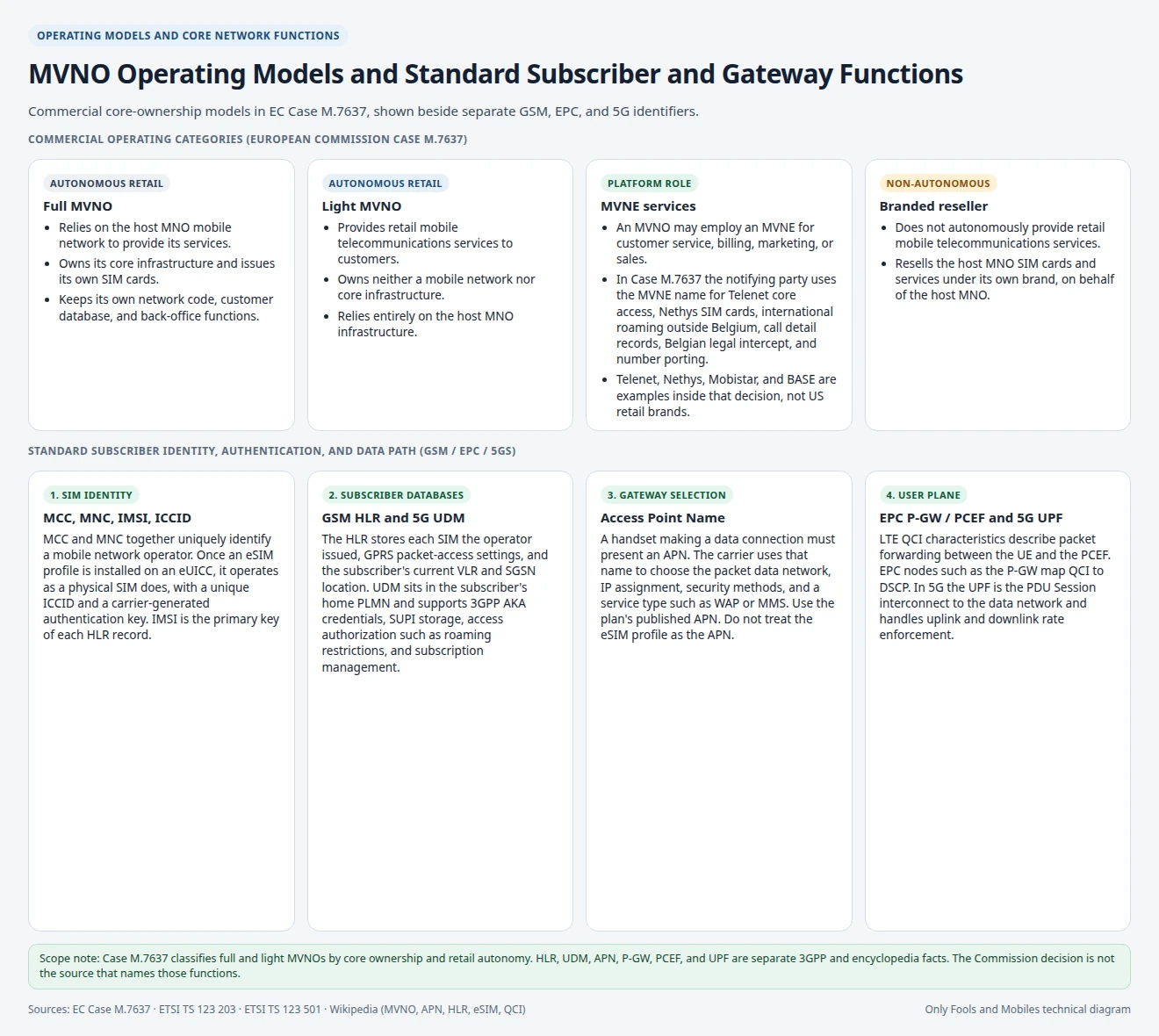
European Commission Case M.7637 (decision of February 4, 2016) defines wholesale operating models according to core-network ownership and retail autonomy:
- Full MVNO: Relies on the mobile network of an MNO to provide its services, while owning its core infrastructure, issuing its SIM cards, and maintaining its own network code, database of customers, and back-office functions to manage customer relations.
- Light MVNO: Relies on a host MNO’s mobile network to provide retail services, owns neither a mobile network nor core infrastructure, and relies entirely on the infrastructure of the host MNO to provide its services. Both full and light MVNOs provide retail mobile telecommunications services to customers.
- Branded reseller: Does not autonomously provide retail mobile telecommunications services, instead reselling the SIM cards and services of an MNO under its own brand on behalf of the host MNO.
- MVNE services: An MVNO may employ a mobile virtual network enabler for its customer service, billing support systems, marketing, and sales personnel. Illustrating with Belgian operators in Case M.7637 (distinct from US retail brands), BASE operated as an MNO owning its mobile network, while Telenet operated as a full MVNO owning its core network and relying on wholesale access to MNO Mobistar; Telenet supplied Mobile Virtual Network Enabler (“MVNE”) services for Nethys, covering access to Telenet’s core network, SIM card provision, international roaming outside Belgium, maintenance of mobile call detail records, legal intercept services under Belgian law, and number porting services.
Separately from the Commission’s commercial definitions, 3GPP specifications and technical references define the subscriber and user-plane functions that authenticate SIMs and route packet sessions. The mobile country code (MCC) and mobile network code (MNC) together uniquely identify a mobile network operator. In GSM core networks, the Home Location Register (HLR) is the central database of subscribers authorized to use the GSM core network: HLRs store details of every SIM card issued by the operator using the unique International Mobile Subscriber Identity (IMSI) as the primary key (one IMSI/MSISDN pair can be associated with only one logical HLR per public land mobile network (PLMN) at a time), along with General Packet Radio Service (GPRS) packet-access settings and the subscriber’s current VLR and serving GPRS support node (SGSN) location.
In 5G systems under ETSI TS 123 501 V18.7.0, Unified Data Management (UDM) is located in the subscriber’s home PLMN (HPLMN), accesses the UDR in the same PLMN, and supports generation of 3GPP AKA authentication credentials, user identification handling (storage and management of SUPI for each subscriber), access authorization based on subscription data (such as roaming restrictions), and subscription management; when UDM and HSS are deployed as separate network functions, their interaction is defined in TS 23.632 and TS 29.563 or is implementation specific. On the user plane, LTE Evolved Packet Core (EPC) nodes — such as the PDN Gateway (P-GW), Mobility Management Entity (MME), and Policy and Charging Rules Function (PCRF) — map QCI to transport-layer Differentiated Services Code Point (DSCP) values, whereas in 5G the User Plane Function (UPF) acts as the external PDU Session interconnect to the Data Network, performs packet routing and forwarding (such as Uplink classifier routing, multi-homed Branching point support, and 5G VN group forwarding), and handles user-plane QoS including uplink/downlink rate enforcement and downlink Reflective QoS marking.
How do domestic roaming and APN settings differ on MVNOs?
Roaming enables a cellular customer to automatically make and receive voice calls, send and receive data, or access other services (including home data services) when traveling outside the home network’s geographical coverage area by using a visited (“visitor”) network. For a subscriber to register onto a visited network, a roaming agreement needs to be in place between the visited network and the home network: the visited network contacts the home network using the device’s IMSI number to request service information, including whether the mobile is allowed to roam, and if there is no roaming agreement between the two networks, maintenance of service is impossible and the visited network denies service.
National roaming refers to moving from one mobile operator to another within the same country. As an encyclopedia example, a postpaid subscriber of T-Mobile USA allowed to roam on AT&T Mobility and/or regional carriers Viaero Wireless and U.S. Cellular holds national roaming rights, whereas prepaid providers typically allow a more restricted national roaming ability for cost reasons. In FCC 21-121, the FCC defines roaming service as a service one mobile wireless provider purchases from another mobile wireless provider so the first provider’s subscribers, when traveling outside its service area, can use the roaming provider’s facilities to place and receive calls, continue in-progress calls, and transmit and receive data; the FCC maintains a dispute-resolution framework for negotiating commercially reasonable data roaming agreements in good faith, and records that the applicants failed to demonstrate that TracFone, absent the merger, could not have negotiated to include international roaming in its wholesale agreements with one or more of its host facilities-based providers.
Separately from coverage and roaming, an Access Point Name (APN) is the name of a gateway between a mobile network (GSM, GPRS, 3G, 4G, and 5G) and another computer network, frequently the public Internet. A mobile device making a data connection must be configured with an APN to present to the carrier, which examines that identifier to determine IP address assignment, security methods, whether to connect the device to a private customer network, which packet data network (PDN) the user wants to reach, and which service types (such as a Wireless Application Protocol (WAP) server or Multimedia Messaging Service (MMS)) that PDN provides. Configure the device with the plan’s published APN values.
Which US prepaid and cable brands operate as MVNOs?
In the US wireless market, MVNO brands include both carrier-owned prepaid subsidiaries and independent or cable resellers. As noted in the Wikipedia MVNO overview, the three US national carriers hold partial or full ownership of several large MVNO brands, such as Cricket Wireless (AT&T), TracFone Wireless and Visible by Verizon (Verizon), and Mint Mobile and Metro by T-Mobile (T-Mobile).
In FCC 21-121 (reviewing the application for transfer of control of TracFone Wireless to Verizon), TracFone stated that it was not a facilities-based mobile network operator, did not hold wireless radio licenses, and operated as an MVNO using MNO networks to offer prepaid plans under the names SafeLink Wireless, Straight Talk Wireless, Net10 Wireless, Walmart Family Mobile, Total Wireless, Go Smart Mobile, Page Plus, and Simple Mobile. The same FCC order notes that dozens of MVNOs beyond TracFone serve retail customers, and that cable companies such as Altice, Comcast, and Charter entered the mobile wireless market through MVNO arrangements. Those corporate structures describe wholesale versus facilities-based operation rather than ranking plan speed.
Can you bring your own unlocked phone to an MVNO?
Bringing your own phone to an MVNO requires both freedom from carrier SIM restrictions and compatibility with the host MNO’s radio network. A factory-unlocked phone is sold without a carrier SIM restriction, whereas a carrier phone may start locked and become unlocked after its provider’s requirements are met; unlocking changes that restriction without necessarily changing installed apps, firmware, radio support, or eligibility on another network. Verify regional model bands and carrier IMEI eligibility on our unlocked versus carrier phone band support and bloatware guide.
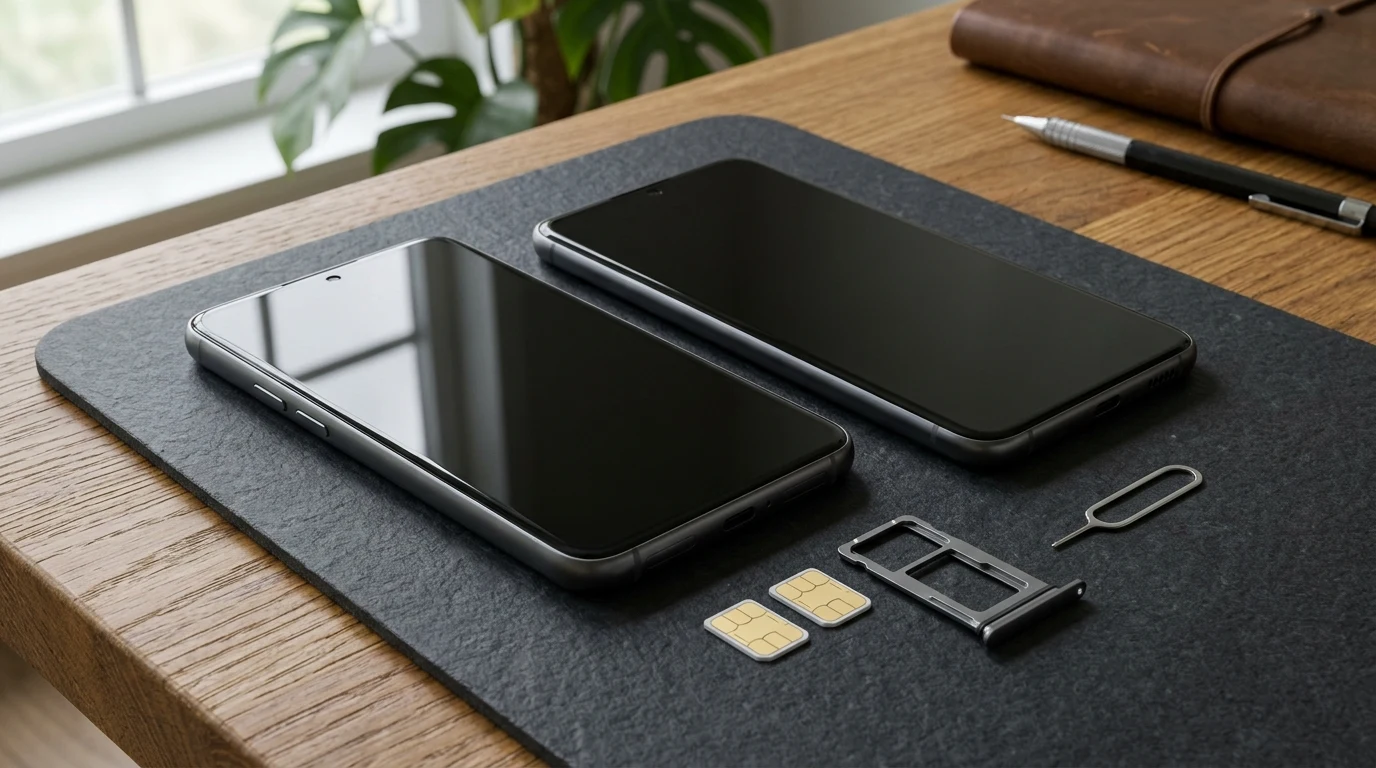
If you activate via eSIM — an embedded subscriber identity module installed as software onto an eUICC chip via remote SIM provisioning — users can connect to and change mobile network operators in device settings without swapping a physical card, a single eSIM plan can connect to several mobile network operators, and devices can hold upwards of 20 eSIM plans simultaneously with 1 or 2 active (with GSMA maintaining SGP.22 for consumer devices, SGP.02 for M2M devices, and SGP.32 published in May 2023 for unattended IoT deployments). Check one hardware lock detail before buying a secondhand carrier handset for eSIM use: if a phone is bought directly from a carrier with a SIM lock, the phone can only add eSIMs from the carrier that locked the phone, even after a carrier unlock. Compare physical card portability and embedded profile trade-offs in eSIM versus physical SIM card switching and theft security.
Once an eSIM carrier profile is installed on an eUICC, it operates in the same way as a physical SIM with a unique ICCID and a carrier-generated network authentication key. That eSIM authentication profile is distinct from packet gateway configuration: your mobile device must still be configured to present the plan’s published APN to establish mobile data and MMS connections.
Pre-switch checklist before moving to an MVNO plan
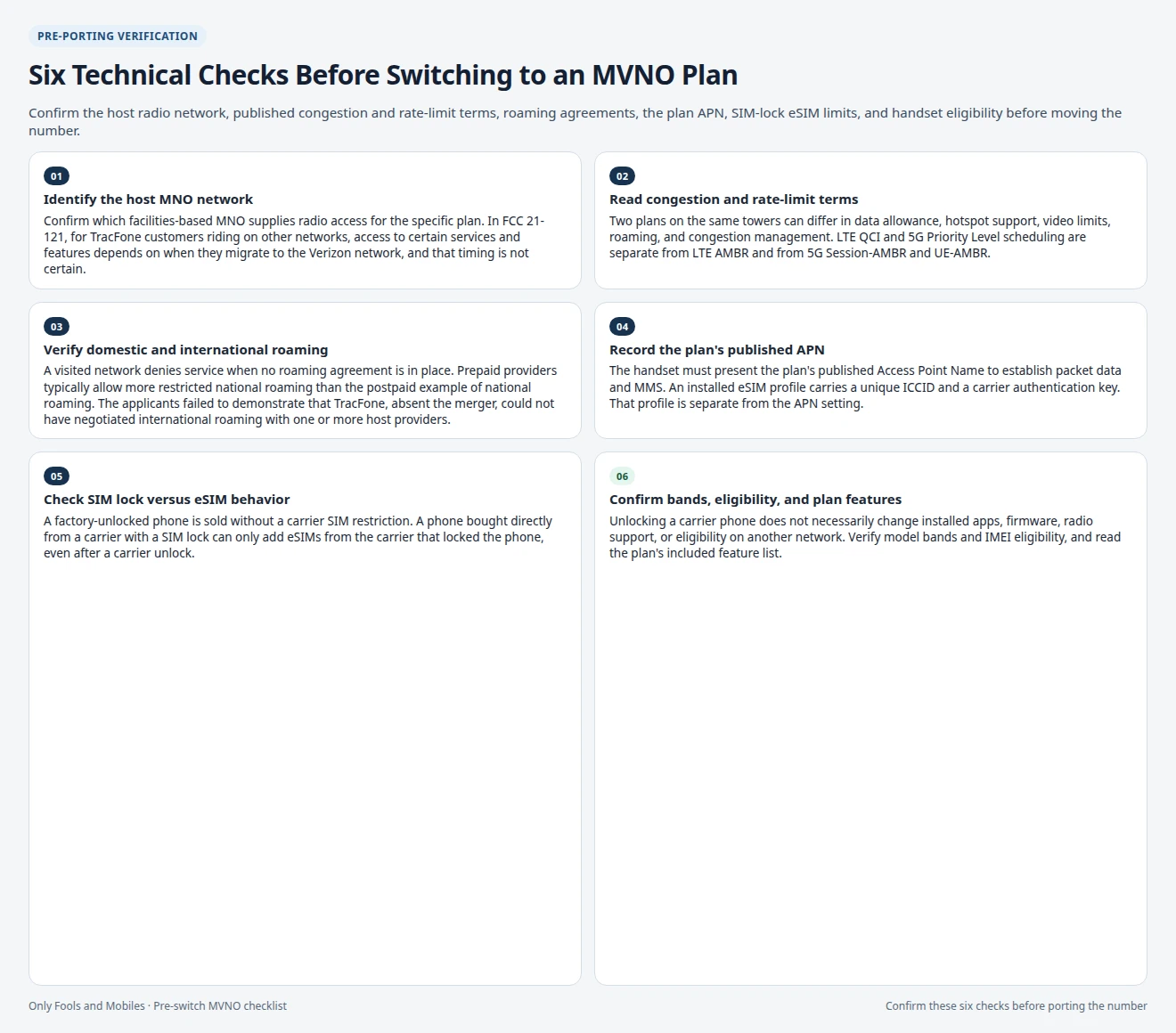
Work through these six verification items before porting your number or activating an MVNO line:
| Checklist item | What to verify before switching | Why it matters on shared towers |
|---|---|---|
| Host MNO identity | Confirm which facilities-based MNO provides radio access for the specific plan | Radio service uses the host MNO’s licensed spectrum and cellular infrastructure, and FCC 21-121 notes that for TracFone customers who ride on other networks, access to certain services and features depends on when they migrate to the Verizon network, and that the timing is not certain |
| Congestion and rate-cap terms | Read the plan’s published network-management policy, hotspot rules, and video limits | LTE QCI and 5G 5QI scheduling priority under congestion are separate from LTE default-bearer AMBR differentiation and 5G Non-GBR Session-AMBR and UE-AMBR rate limits |
| Domestic and international roaming | Check published off-network domestic roaming and international roaming terms | Visited networks deny registration without a roaming agreement, and prepaid national roaming is typically more restricted than postpaid roaming |
| Plan APN configuration | Record the exact published Access Point Name instructions from the MVNO | A handset must present the plan’s APN so the network selects the right PDN, IP assignment, and MMS service |
| eSIM profile versus SIM lock | Check whether the handset is factory-unlocked or originally sold carrier-locked | A phone bought directly from a carrier with a SIM lock can only add eSIMs from that locking carrier, even after a carrier unlock |
| Bands, IMEI, and plan features | Run the carrier compatibility check, verify LTE and 5G bands, and read the plan’s included feature list | Unlocking a carrier phone does not necessarily change installed apps, firmware, radio support, or eligibility on another network |
For model-specific frequency checks, SIM-unlock rules, and IMEI verification before activating a line, continue to unlocked versus carrier phone band support and bloatware, or use our SIM plans and mobile troubleshooting hub if voice, SMS, or mobile data fails after activation.
Sources
The regulatory filings, competition decisions, 3GPP QoS specifications, and technical references used in this guide include:
- Mobile virtual network operator — Wikipedia
- Mobile network operator — Wikipedia
- QoS Class Identifier — Wikipedia
- Access Point Name — Wikipedia
- Home Location Register — Wikipedia
- Roaming — Wikipedia
- eSIM — Wikipedia
- FCC 21-121 Memorandum Opinion and Order (Verizon / TracFone) — Federal Communications Commission
- Case M.7637 — Liberty Global / BASE Belgium Decision (February 4, 2016) — European Commission
- ETSI TS 123 203 V19.2.0 (3GPP TS 23.203 Release 19) — Policy and charging control architecture
- ETSI TS 123 501 V18.7.0 (3GPP TS 23.501 Release 18) — System architecture for the 5G System (5GS)
Related technical guides
Dual SIM DSDS vs DSDA Radio Modes
Compare DSDS versus DSDA Android dual SIM standby versus dual active radio behavior, second SIM call and data rules, eSIM MEP, and model checks.
Read technical guide
Android eSIM Transfer When the QR Code Is Already Consumed
Fix an Android eSIM transfer when a scanned QR code fails as already used or bound. Check existing profiles, run device-to-device transfer, or use your EID.
Read technical guide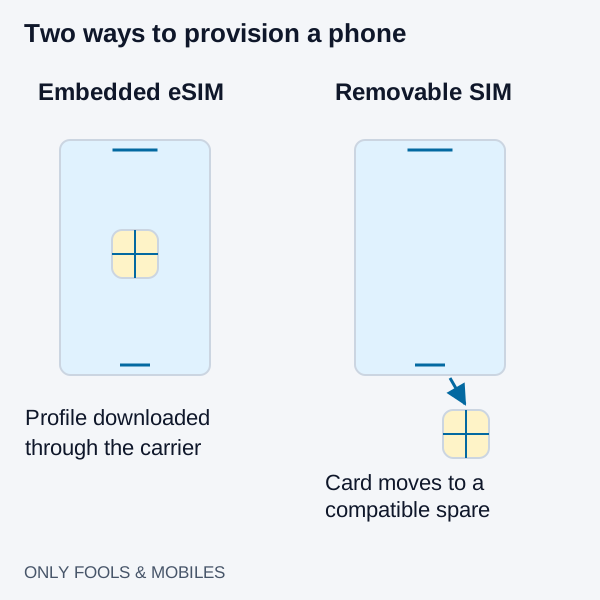
eSIM vs. Physical SIM Card: Carrier Switching, Roaming, and Theft Security
Compare eSIM and physical SIM for travel, broken-phone recovery and theft protection, with carrier-specific activation and roaming checks.
Read technical guide