GSM vs CDMA: Unlocked Phone Compatibility
After US 3G shutdowns, GSM vs CDMA labels do not decide unlocked phone compatibility. Check LTE and 5G NR bands, the VoLTE profile, and the IMEI result.
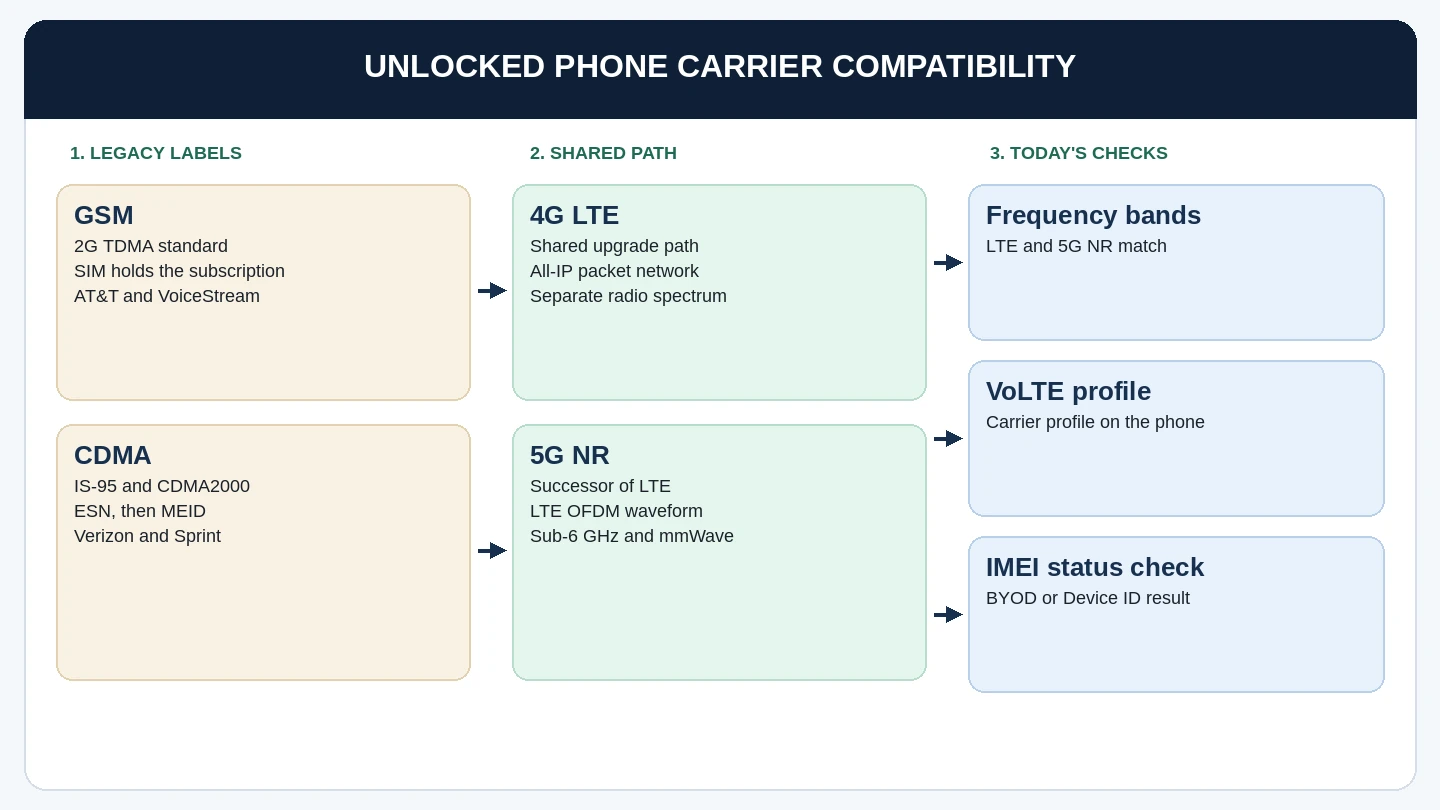
After US 3G network shutdowns, a GSM-versus-CDMA label no longer decides whether an unlocked phone works on a US carrier. Mobile carriers shut down their 3G networks to make room for more advanced network services, including 5G, leaving 3G mobile phones and certain older 4G mobile phones that do not support Voice over LTE (VoLTE or HD Voice) unable to make or receive calls and texts, including calls to 911, or use data services. LTE became the de facto industry standard upgrade path for carriers with both GSM/UMTS networks and CDMA2000 networks, and 5G NR is the successor of LTE.
Historically, the US radio split separated SIM-card authentication on AT&T and T-Mobile GSM networks from ESN and MEID equipment identifiers on Verizon and Sprint CDMA networks. GSM relied on a detachable Subscriber Identity Module (SIM card) holding the user’s subscription, whereas legacy CDMA phones identified physical handsets through Electronic Serial Numbers (ESNs) and later Mobile Equipment Identifiers (MEIDs). Today, compatibility for an unlocked phone rests on three checks: matching 4G LTE and 5G NR frequency bands, having the carrier’s VoLTE profile on the device, and passing the carrier’s IMEI status check.
An unlocked phone lets you choose a compatible carrier without first removing a SIM lock, though it does not guarantee that every network feature will work; review model and activation checks on our budget unlocked smartphones guide. A factory-unlocked phone is sold without a carrier SIM restriction, and unlocking a carrier phone changes that software restriction without necessarily changing firmware, radio support, or eligibility on another network, as detailed in unlocked versus carrier phones. Network SIM unlocking is separate from fastboot partition access, covered in carrier unlock versus bootloader unlock.
Were Verizon and T-Mobile historically CDMA or GSM networks?
Before Verizon’s LTE network launched, Verizon operated an exclusively CDMA2000 network, with Sprint as the other major CDMA2000 carrier in the United States. Sprint used CDMA, EV-DO, and 4G LTE networks, and formerly operated iDEN, WiMAX, and 5G NR networks; although the Sprint PCS service was CDMA, its original Washington-area network used GSM. Because 4G LTE is a data-transmitting network, Verizon customers’ voice calls were still carried over Verizon’s 3G CDMA2000 network when LTE launched until Verizon introduced VoLTE in September 2014.
On the GSM side, T-Mobile’s predecessor VoiceStream Wireless PCS was established in 1994 as a Western Wireless subsidiary to provide wireless personal communications services (PCS) in 19 FCC-defined metropolitan service areas in several western and southwestern states using the GSM digital wireless standard. That initial 2G GSM network was first turned on in Honolulu and Salt Lake City by 1996. In 2005, AT&T launched its BroadbandConnect 3G network based on UMTS and HSDPA to counter Verizon Wireless and Sprint EV-DO networks, and on January 1, 2017, AT&T Mobility discontinued its 2G GSM network.
Are modern iPhones and Android phones GSM or CDMA?
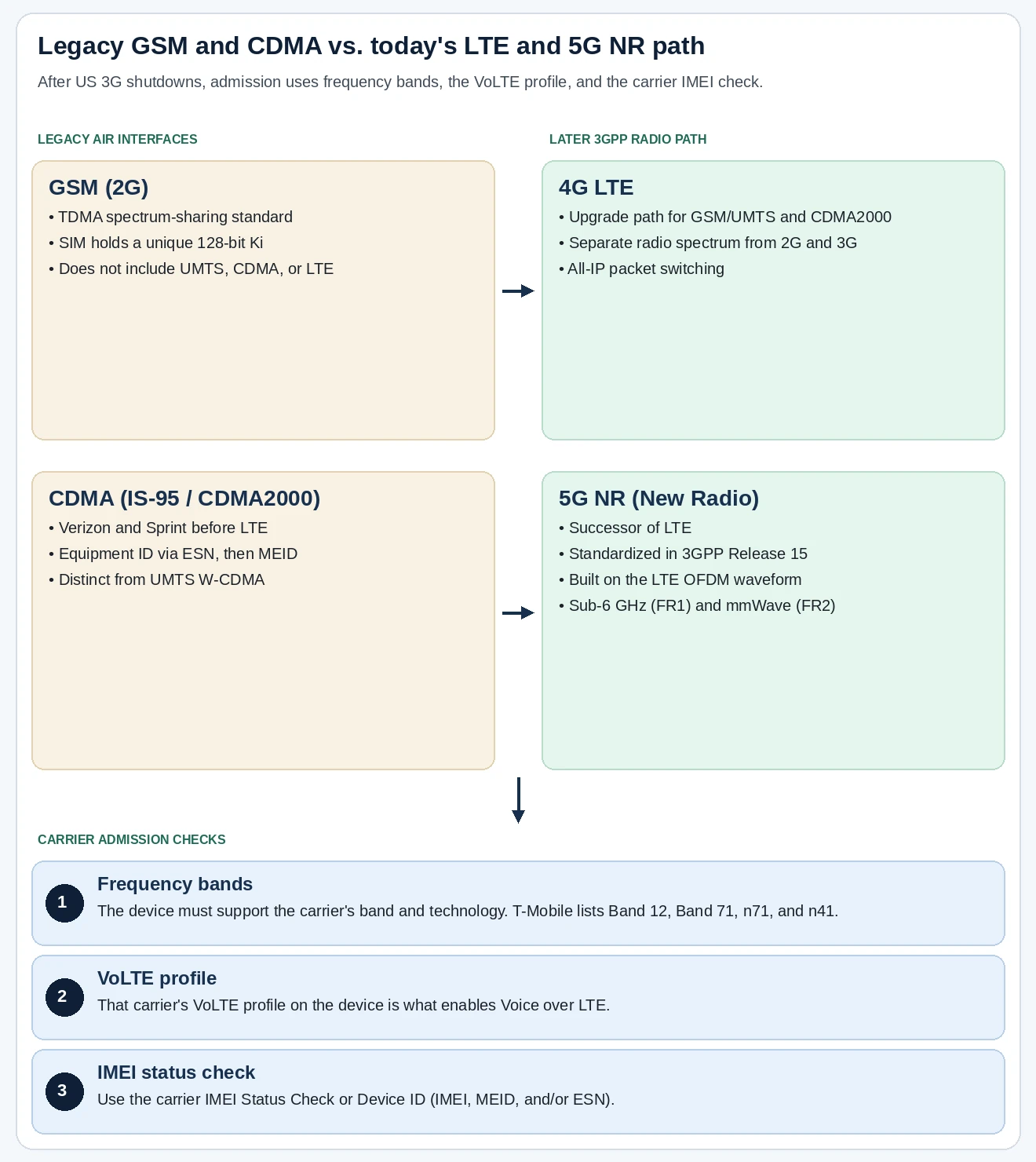
As of 2026, almost all public CDMA2000 networks have been shut down, usually to be replaced by LTE and/or 5G NR networks. Current iPhones and Android smartphones are LTE and 5G NR devices rather than GSM or CDMA handsets. The LTE wireless interface is incompatible with 2G and 3G networks, so it must be operated on a separate radio spectrum, while 5G NR (5G New Radio) is a 3GPP radio access technology designed to be the global air interface for 5G networks, with the technical details in the 3GPP specification 38 series. Standardized initially in 3GPP Release 15, 5G NR builds upon the orthogonal frequency-division multiplexing (OFDM) waveform principles established in 4G LTE and operates across both sub-6 GHz (FR1) and millimeter-wave (FR2) frequency bands. Rather than assigning a current phone model a GSM or CDMA class, verify compatibility with the carrier’s IMEI check.
Beginning in the late 2010s, various carriers worldwide started to shut down their GSM networks; nevertheless, because of the network’s widespread use, the acronym GSM is still used as a generic term for mobile phone technologies evolved from it. In original GSM networks, changing the detachable SIM card changed the network identity unless an operator restricted the handset to its own network through software SIM locking. Each GSM SIM holds a unique 128-bit Ki secret stored both on the card and in the carrier’s authentication center (AuC), providing the Run GSM Algorithm function so the phone passes data to the SIM to be signed with the Ki.
SIM cards are typically used on GSM phones; CDMA phones historically did not use SIM cards, though the Removable User Identity Module (R-UIM) format appeared in certain CDMA devices. Electronic serial numbers (ESNs) were created by the Federal Communications Commission (FCC) to uniquely identify mobile devices, from the days of AMPS in the United States starting in the early 1980s, with administration taken over by the Telecommunications Industry Association in 1997, and ESNs are currently mainly used with CDMA phones, while GSM phones do not have an ESN or MIN and use an International Mobile Equipment Identity (IMEI) number. After 3GPP2 created the MEID format, first implemented by Verizon in 2006 before virgin ESNs were exhausted in November 2008, CDMA2000 equipment used hexadecimal MEIDs always starting with 0xA0 or larger in the first two hexadecimal digits. Under 3GPP TS 23.003, an IMEI has 15 decimal digits (14 digits plus a check digit, or 16 decimal digits in an IMEISV with two software version digits) using decimal digits 0 through 9 only, and its initial 8-digit Type Allocation Code (TAC) identifies the model and origin. A listing that says only global unlocked is insufficient to establish US compatibility.
How do you check whether an unlocked phone works on a US carrier?
T-Mobile’s quick tip tells buyers to check phone compatibility using its IMEI Status Check without comparing network frequencies or device lists manually. On the same network support page, T-Mobile states that to connect to the local network, your device must support both its network frequency (band) and the technology (5G, 4G LTE, 2G).
To be eligible for bring-your-own-device (BYOD) service on Verizon, your device must be unlocked and its hardware and software must be compatible with the Verizon mobile network, allowing activation on a new or existing Verizon plan. Bringing a phone to Verizon requires knowing the Device ID (IMEI, MEID, and/or ESN), and the device’s SIM card or eSIM must be compatible with the Verizon mobile network. Mint Mobile likewise tells bring-your-own-phone buyers to make sure the handset is compatible and unlocked.
If you purchased a phone independent of a mobile provider, the FCC consumer guide notes that you should be able to check whether the device is 4G LTE (with VoLTE or HD Voice) enabled by checking the phone’s settings or user manual, or by searching the phone’s model number online. Some devices may only require a software update to enable VoLTE (HD Voice) or other advanced services, while some carrier websites publish lists of devices that are no longer supported after 3G networks shut down.
How do GSM and CDMA labels relate to LTE and 5G today?
Issued by the European Telecommunications Standards Institute (ETSI), GSM is a second-generation (2G) standard employing time-division multiple-access (TDMA) spectrum-sharing, and the GSM standard does not include 3G Universal Mobile Telecommunications System (UMTS), code-division multiple access (CDMA) technology, or the 4G LTE orthogonal frequency-division multiple access (OFDMA) standards issued by 3GPP. Maintenance and specifications of GSM passed to 3GPP in 2000, which developed 3G UMTS, 4G LTE Advanced, and 5G standards outside the GSM standard. IS-95, also called cdmaOne, and its 3G evolution CDMA2000, are often simply referred to as CDMA, whereas UMTS, the 3G standard used by GSM carriers, uses wideband CDMA (W-CDMA) along with TD-CDMA and TD-SCDMA as radio technologies; carriers including AT&T, UScellular, and Verizon shut down 3G CDMA-based networks in 2022 and 2024, rendering handsets limited to those protocols unusable for calls, even to 911.
CDMA2000’s intended 4G successor was Ultra Mobile Broadband (UMB), until Qualcomm announced in November 2008 that it was ending UMB development in favor of LTE. On July 28, 2011, Sprint announced it was ending its 4G WiMAX rollout in favor of more internationally accepted LTE technology, and major CDMA operators (such as Verizon, Sprint and MetroPCS in the United States, Bell and Telus in Canada, au by KDDI in Japan, SK Telecom in South Korea, and China Telecom and China Unicom in China) have announced they intend to migrate to LTE. Specified in the 3GPP Release 8 document series with minor enhancements in Release 9, LTE is also called 3.95G and has been marketed as 4G LTE and Advanced 4G, but the original version did not meet the technical criteria of a 4G wireless service, as specified in the 3GPP Release 8 and 9 document series for LTE Advanced, which is officially defined as a true 4G technology and also named LTE+, and in the 2020s LTE and LTE Advanced networks are being supplemented and replaced with 5G NR.
Because the LTE standard supports only packet switching with its all-IP network while voice calls in GSM, UMTS, and CDMA2000 are circuit switched, carriers will have to re-engineer their voice call network. In that approach, LTE provides data services and a voice call falls back to the circuit-switched domain; operators need to upgrade the MSC instead of deploying the IMS, and the disadvantage is a longer call setup delay. VoLTE is based on the IP Multimedia Subsystem (IMS) architectural framework, with specific profiles for the control and media planes of voice service on the LTE wireless broadband service defined by GSMA in PRD IR.92, so those planes travel as data flows inside the LTE data bearer with no dependency on the circuit-switched voice network being in the call path.
To make a VoLTE call, the device, its firmware, and the mobile telephone providers on each end, as well as the inter-carrier connectivity, must all implement the service in the area and work together. Each phone service provider enables voice on its LTE network through carrier-specific VoLTE profiles, and device manufacturers update handsets with each operator’s profile; when a mobile provider’s VoLTE profile is present on the phone, the operating system automatically connects and enables Voice over LTE. Some providers’ VoLTE service was incompatible with other providers’ equipment, and older LTE devices without VoLTE compatibility relied on 3G or 2G for calling.
Which US carriers sat on each side, and when did 3G shut down?
As mobile carriers upgrade their networks, they periodically shut down older services such as 3G to free up spectrum and infrastructure for newer services such as 5G. Each US operator retired its legacy 2G and 3G radio layers on separate dates:
- AT&T (GSM and UMTS heritage): After shutting down 2G GSM on January 1, 2017, AT&T discontinued its 3G UMTS network on February 22, 2022. The FCC 3G shutdown guide records that AT&T announced it phased out its 3G network beginning in February 2022.
- Verizon (CDMA2000 heritage): In 2019, Verizon announced plans to shut down its CDMA2000 network by the end of 2020, making VoLTE the only calling path on its network. Verizon intended to retire its 2G and 3G CDMA network in favor of LTE and 5G on January 1, 2021, halted that retirement indefinitely, and later confirmed retirement on December 31, 2022, requiring customers with CDMA-only devices or LTE devices without VoLTE to upgrade before completing the shutdown at the end of 2022. Verizon’s band-list note records that its CDMA network was shut down on December 31, 2022, and the FCC guide records that Verizon announced it would finish shutting down its 3G network by December 31, 2022.
- Sprint (CDMA2000 heritage): Following Sprint’s 2020 acquisition by T-Mobile US, the Sprint encyclopedia entry states that Sprint’s CDMA network was completely shut down on May 31, 2022. The archived FCC guide records that T-Mobile announced it finished shutting down Sprint’s 3G CDMA network as of March 31, 2022, and Sprint’s 4G LTE network as of June 30, 2022.
- T-Mobile (GSM and UMTS heritage): T-Mobile decommissioned its 3G UMTS network in July 2022, which the FCC guide dates to July 1, 2022 while noting T-Mobile had not yet announced a 2G shutdown date at that capture. In January 2025, T-Mobile US announced the planned retirement of its GSM network scheduled to begin on February 9, 2025, and later announced that the GSM network will be fully decommissioned by August 3, 2026.
The sources below name a host network for these prepaid brands and mobile virtual network operators and do not give those brands a separate GSM or CDMA radio type. The FCC guide notes that Cricket, Boost, Straight Talk, and several Lifeline mobile service providers utilize AT&T’s, Verizon’s, and T-Mobile’s networks. T-Mobile offers services under T-Mobile and Metro by T-Mobile (acquired in a 2013 reverse takeover of MetroPCS), operates the federal Lifeline service Assurance Wireless from the 2020 Sprint acquisition, and acquired low-cost MVNOs Mint Mobile and Ultra Mobile in 2024 as separate brands.
Does Mint Mobile run on a GSM-heritage network?
Mint Mobile, LLC is a prepaid mobile virtual network operator owned by T-Mobile US. Mint Mobile’s coverage page states that Mint runs on T-Mobile, whose predecessor VoiceStream Wireless used the GSM standard. Because T-Mobile decommissioned its UMTS network in July 2022 and scheduled GSM retirement to begin on February 9, 2025 and finish by August 3, 2026, and because Mint runs on T-Mobile, a phone connecting to that network must support T-Mobile’s frequency band and the technology (5G, 4G LTE, 2G), T-Mobile’s VoLTE service is available nationwide for calls on the LTE data network, and Mint tells bring-your-own-phone buyers to make sure the handset is compatible and unlocked.
Which LTE and 5G NR bands do US carriers list?
Both AT&T and Verizon employ published lists of known 4G LTE and 5G NR frequencies in the United States. AT&T’s network footprint supports 4G using LTE and LTE-Advanced for simultaneous packet-switched voice and data communications while rolling out 5G based on the NR specification.
T-Mobile’s network support page publishes specific 5G and 4G LTE band rows. For 5G, T-Mobile pairs Extended Range 5G, providing nationwide indoor, urban, and rural coverage with faster speeds than 4G LTE, with Band n71 (600 MHz), and pairs Ultra Capacity 5G on mid-band and/or mmWave spectrum with Band n41 (2.5 GHz). In early 2017, T-Mobile purchased 45% of available 600 MHz spectrum in the United States covering 100% of the US geographically, and on July 11, 2019, T-Mobile and Ericsson completed their first n71 (600 MHz) lab data session in Bellevue, Washington on the Snapdragon X55, the first commercial 5G modem to feature n71.
For 4G LTE, T-Mobile lists Band 12 (700 MHz), which T-Mobile calls Extended-range LTE for building penetration and reach beyond PCS and AWS spectrum, alongside LTE Band 71 (600 MHz), which is distinct from 5G NR Band n71. T-Mobile states that VoLTE lets users make and receive calls while connected to the LTE data network nationwide, whereas on its 2G (GSM, GPRS, EDGE) row voice and data services do not work at the same time during a call.
Pre-SIM unlocked phone compatibility checklist
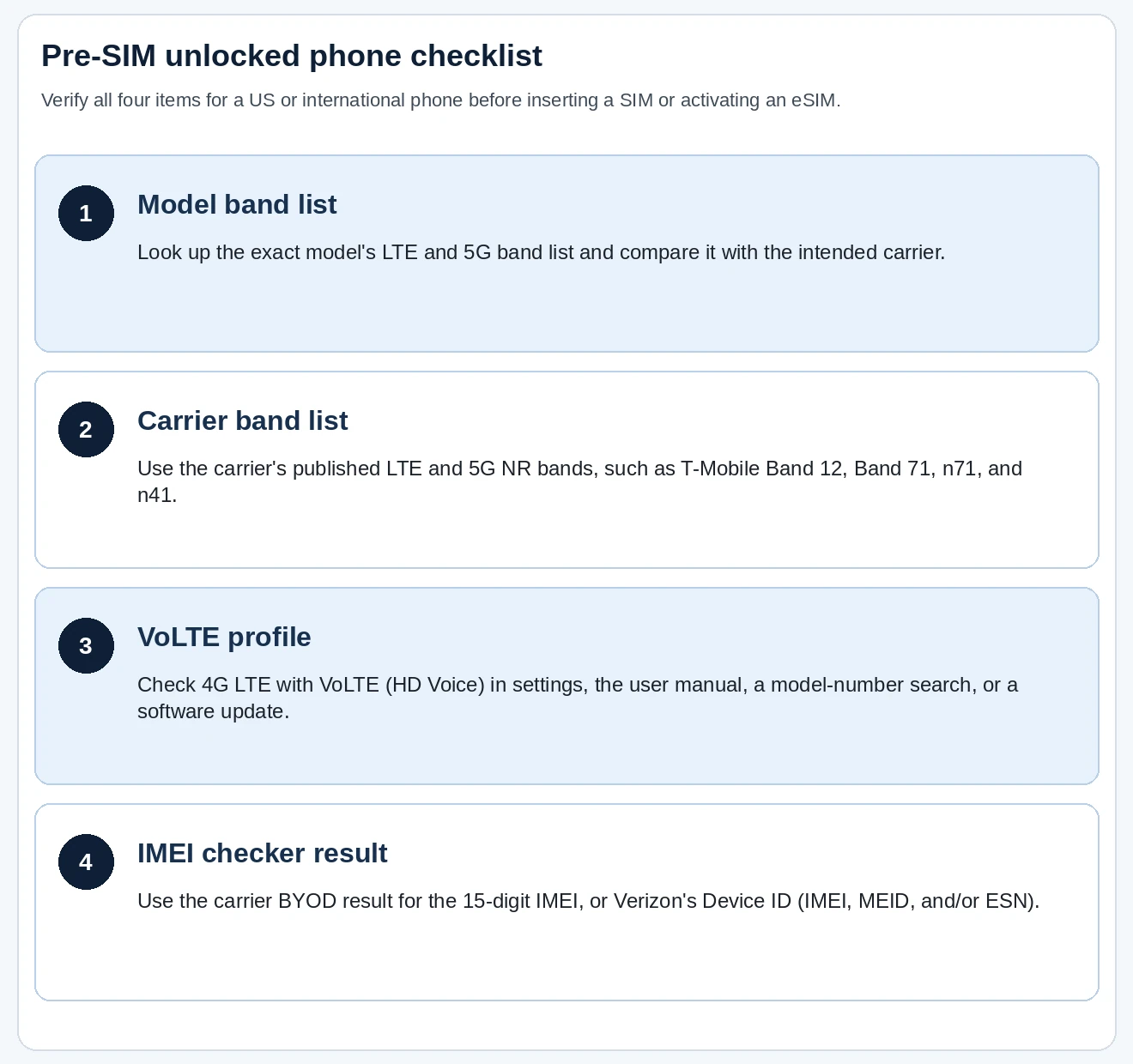
Verify and record all four items below for a US or international unlocked phone before inserting a SIM card or activating an eSIM:
| Check | What to verify before inserting the SIM |
|---|---|
| Model band list | Exact model’s LTE and 5G band list, compared with the intended carrier’s network |
| Carrier band list | Target carrier’s published US 4G LTE and 5G NR frequency bands (such as T-Mobile Band 12, Band 71, Band n71, and Band n41) |
| VoLTE profile | That carrier’s VoLTE profile on the phone, or a 4G LTE (with VoLTE or HD Voice) check in settings, the user manual, a model-number search, or a software update |
| IMEI checker result | Carrier BYOD status check for the actual 15-digit IMEI, or Verizon’s Device ID check using IMEI, MEID, and/or ESN |
After the carrier BYOD result for that IMEI, confirm voice, data, Wi-Fi Calling, and eSIM separately, and on Verizon confirm that the device’s SIM card or eSIM is compatible with the Verizon mobile network.
Sources
The cellular standards, carrier histories, and 3G shutdown timelines above are documented in these primary and encyclopedia references:
- GSM — Wikipedia
- Code-division multiple access — Wikipedia
- CDMA2000 — Wikipedia
- LTE (telecommunication) — Wikipedia
- Voice over LTE — Wikipedia
- 5G NR — Wikipedia
- SIM card — Wikipedia
- International Mobile Equipment Identity — Wikipedia
- Mobile equipment identifier — Wikipedia
- Electronic serial number — Wikipedia
- AT&T Mobility — Wikipedia
- Verizon (wireless service) — Wikipedia
- T-Mobile US — Wikipedia
- Sprint Corporation — Wikipedia
- Mint Mobile — Wikipedia
- Plan Ahead for Phase Out of 3G Cellular Networks and Service — FCC
Related technical guides
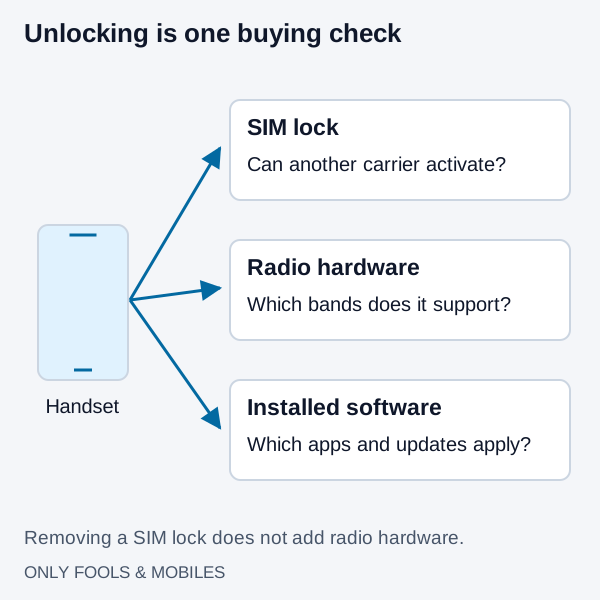
Unlocked vs. Carrier Phone: Band Support, Bloatware, and 2026 Unlock Rules
Compare factory-unlocked and carrier phones, check hardware separately from SIM locks, and review Verizon, AT&T and T-Mobile eligibility conditions.
Read technical guide
Carrier Unlock vs Bootloader Unlock
Compare carrier unlock versus bootloader unlock permissions, why a phone is carrier unlocked with a locked bootloader, and how to check OEM unlocking.
Read technical guide
Dual SIM DSDS vs DSDA Radio Modes
Compare DSDS versus DSDA Android dual SIM standby versus dual active radio behavior, second SIM call and data rules, eSIM MEP, and model checks.
Read technical guide