Dual SIM DSDS Versus DSDA and Which Radio Sleeps
Compare DSDS versus DSDA Android dual SIM standby versus dual active radio behavior, second SIM call and data rules, eSIM MEP, and model checks.
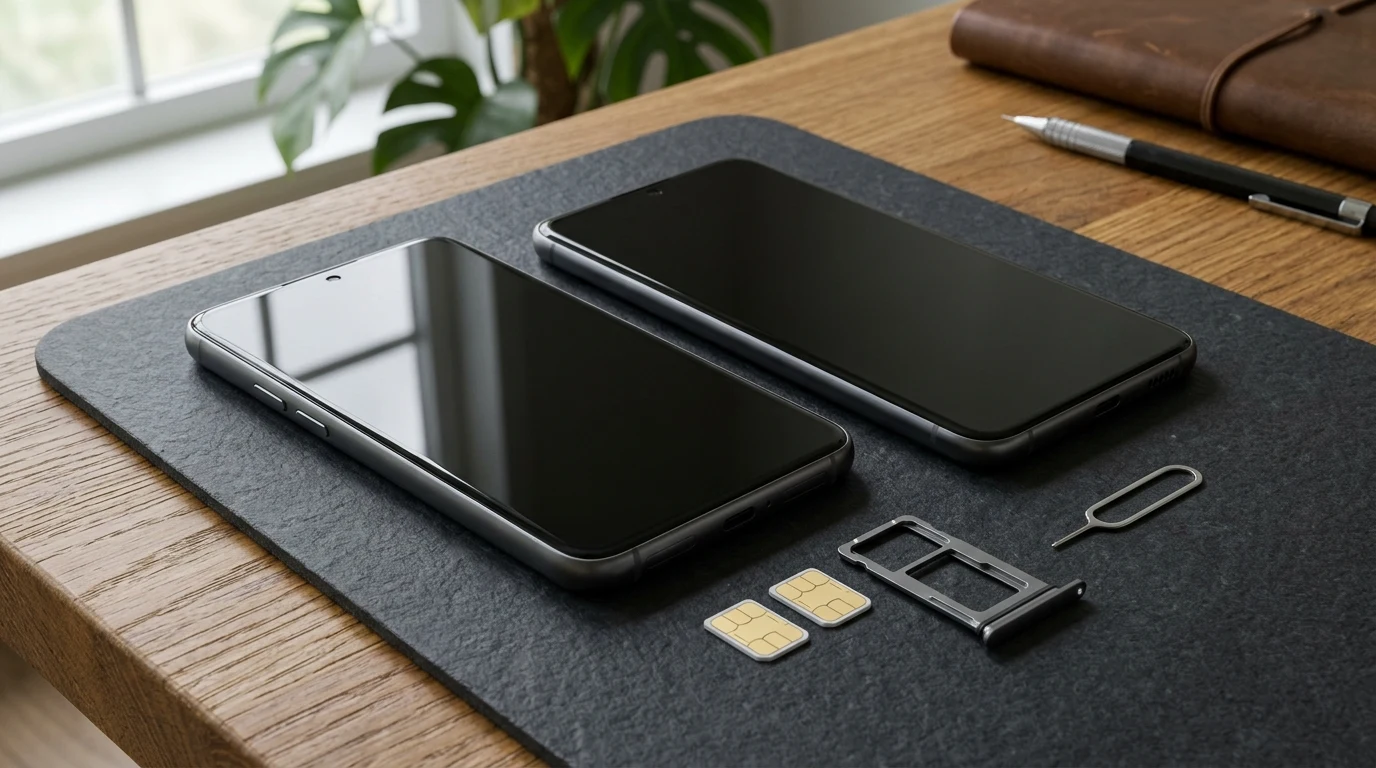
Choosing the wrong dual SIM radio mode can cause missed voice calls, paused background data, or delayed verification texts when one line becomes active.
In DSDS architecture, both SIM cards share the device transceiver resources and remain in standby mode, but once one SIM becomes active in a call or data session, the other is temporarily suspended.
In DSDA architecture, dedicated transceiver resources are provided for each SIM, enabling both SIMs to maintain simultaneous active connections for voice and data independently.
On Pixel 8 or Pixel 8 Pro and earlier, if a user is on a call, they cannot get a call through the other SIM at the same time, and calls to the other SIM go to voicemail.
Verify whether your handset specification states DSDS or DSDA before pairing a work line and a personal line on the same phone. Pair this radio architecture guide with our SIM plans and mobile troubleshooting hub when configuring dual-line call routing and cellular data fallback.
How DSDS versus DSDA radio architecture and paging work
Comparing dual sim standby versus dual active on Android starts with how the cellular modem schedules idle reception and active transmission across both subscriptions.
In Dual SIM Dual Standby (DSDS), both SIM cards are on standby ready to receive calls and texts, but if one SIM is actively in use (like during a call), the other temporarily goes offline.
In Dual SIM Dual Active (DSDA) phones, both SIMs are active at all times so a user can make or receive calls on one SIM while the other is in use, though it usually comes at a higher price and slightly shorter battery life.
In Dual SIM Single Standby (DSSS), only one SIM is registered at a time and the inactive SIM is effectively offline until switched, so it cannot receive calls or texts such as banking OTP SMS.
In AOSP TelephonyProperties, PROPERTY_MULTI_SIM_CONFIG (persist.radio.multisim.config) sets the multi-SIM feature configuration with string values dsds or dsda.
Signal retries, paging contention, and VoLTE data pause
When a single radio transceiver time-slices between two networks, poor signal quality or an active voice call directly affects the other line.
In Amarisoft lab testing of a commercial DSDS UE, packet data traffic and ping replies on one SIM were paused during an active VoLTE call on the other SIM and resumed after the VoLTE call completed.
On a DSDS phone in marginal 5G NR or LTE signal conditions, error correction and retries make the single cellular modem spend more time on the active SIM, so the other line may miss an incoming call or delay an OTP SMS until the data burst ends.
Review our comparison of eSIM versus physical SIM card switching and theft security when choosing whether to store your two lines on removable plastic cards or embedded profiles.
What happens to the second SIM during a call or data session
When evaluating dsds versus dsda android behavior in daily use, the practical difference appears the moment a voice call or packet session starts on either line.
On a Google Pixel phone in dual SIM mode, only one SIM can be the default for data.
On Pixel 8 or Pixel 8 Pro and earlier, most data goes through the default SIM, with the exception that during a phone call all data goes through the SIM making the call.
To use data during calls on a SIM not normally used for data, the user opens Settings > Network & internet > SIMs and turns on Data during calls.
On Pixel 8a and later, a user can use both SIMs for calls at the same time; when the first SIM is active, placing or answering a call on the second SIM puts the first call on hold.
Using both SIMs for calls on eligible Pixel phones requires turning on mobile data for both SIMs, turning on automatic data switching for the second SIM, and carrier support for Wi-Fi calling on the second SIM.
Samsung Galaxy and Apple iPhone dual SIM call and data rules
Samsung smartphones use three SIM tray types: Single SIM (1 SIM card slot), Dual SIM (2 SIM card slots, labeled SIM2), and Hybrid SIM (1 SIM card slot and a hybrid slot labeled SIM2 \ microSD).
On Samsung dual SIM devices, activating two SIM cards allows receiving calls and messages on both cards, but if the user is speaking on a call using one card, the other card cannot receive new calls at the same time.
On Samsung Galaxy devices, users configure preferred SIM cards for calls, text messages, and mobile data—and can set up call confirmation or Dual SIM always on—under Settings > Connections > SIM card manager.
Apple iPhone Dual SIM with an eSIM uses Dual SIM Dual Standby (DSDS) technology, where only one number at a time can use cellular data.
On an iPhone using Dual SIM, when a user is on a call and the other line shows No Service, incoming calls on the other phone number go to voicemail if you set up voicemail with your carrier, and the user will not get a missed-call notification from the secondary number.
On an iPhone using Dual SIM, if Allow Cellular Data Switching is turned off and the user is active on a voice number that is not the designated cellular-data number, cellular data will not work while on the call.
On an iPhone using Dual SIM, automatic cellular-data switching for the duration of a call will not work if the user is currently using Data Roaming.
Google Pixel DSDS setup, 5G compatibility, and regional SIM layouts
Google Pixel handsets illustrate how hardware generations, network bands, and regional variants shape dual standby operation.
On a Pixel 3a or later Pixel phone, a user can use two SIMs: one physical SIM card and one eSIM, under Dual SIM Dual Standby (DSDS).
In the US only, if a user has a Pixel 10 or later, except the Pixel 10 Pro Fold, they can only use an eSIM.
A user can use 2 eSIM profiles at once on a Pixel 7, Pixel 7 Pro, or later phone when their carrier allows this feature.
A Pixel 3a bought in Japan cannot have two SIMs.
Pixel 4a (5G) and later phones in dual SIM mode can connect to 5G networks.
On US Dual eSIM Pixel hardware configurations, Dual eSIM supports 2 active eSIMs and stores 8 or more eSIMs, while rest-of-world (ROW) configurations use Dual SIM (Single Nano SIM and eSIM).
In Google Pixel Dual SIM hardware configurations with a physical slot in both US and ROW, the SIM configuration is Dual SIM (Single Nano SIM and eSIM).
If your operator rejects a replacement profile or asks for your embedded hardware identifier during dual-line setup, follow our walkthrough on Android eSIM transfer when a QR code is already consumed and EID lookup.
Android dual eSIM MEP versus DSDA and chipset modem claims
Buyers frequently confuse Android’s dual eSIM profile multiplexing with dual active radios, or assume that a flagship modem name guarantees two active transceivers in a retail handset.
On devices running Android 13 or higher, Android supports multiple enabled profiles (MEPs) for eUICC, allowing dual SIM support using a single eSIM chip connected to two carriers at the same time.
On devices running Android 12 or lower without MEP, the eSIM slot only supports a single enabled profile at one time and cannot support DSDS.
In Android 13 or higher on devices with MEP, a single eUICC (a single physical slot) supports dual SIM dual standby (DSDS) by having each eUICC port link to a modem baseband.
For devices running Android 14 or higher, Android supports the MEP-A1 and MEP-B options for ISD-R and eSIM port selection as specified in GSMA SGP V22 3.0.
To support MEP in AOSP, devices must declare the hardware feature flags android.hardware.telephony.euicc and android.hardware.telephony.euicc.mep.
Devices running Android 10 or higher can support multiple eSIMs, while EuiccCardManager APIs provide ES10x functions based on GSMA RSP v2.0.
Chipset DSDA announcements versus shipped smartphone hardware
The MediaTek M80 5G modem is a 3GPP Release 16 standard 5G modem supporting Multimode Dual SIM Dual Active (DSDA) with simultaneously active cellular connections across 5G/5G, 5G/4G, 4G/4G, and Dual VoNR.
The Dimensity 9000+ integrates a 3GPP Release-16 5G modem with 3CC Carrier Aggregation (300MHz), up to 7Gbps downlink, and Dual SIM Dual 4G/5G Active (DR-DSDA).
The MediaTek Dimensity 900 (6nm) supports True Dual 5G SIM (5G SA+SA).
Even when mobile platforms such as Qualcomm Snapdragon 8 Gen 2 and Snapdragon 7+ Gen 2 support Dual SIM Dual Active (DSDA) with 5G + 5G or 5G+ 4G SIM cards, Snapdragon 8 Gen 2 phones Digit tested for the Indian market did not support DSDA connectivity.
Before inserting a second carrier card into a handset purchased through a mobile operator, check our guide on unlocked versus carrier phone band support and lock rules to confirm the device is not restricted to a single network.
Pre-purchase dual SIM verification checklist and frequently asked questions
Before buying or configuring a dual-line handset for work and personal numbers, run through this verification checklist:
- Check whether the official handset specification sheet explicitly states DSDS or DSDA rather than relying on the modem chipset name alone.
- Decide whether the second SIM needs to receive mobile data or text messages during an active voice call on the other line.
- Verify whether your carrier supports call forwarding, call waiting, or Wi-Fi calling across both lines if the phone uses dual standby.
- Confirm whether automatic data switching or dual SIM always on is available in the handset network settings menu.
Checking whether the phone specification explicitly states DSDS or DSDA and whether your second SIM must receive data or texts during a call prevents unexpected missed calls and dropped sessions.
Why do calls to my second SIM go straight to voicemail while I am on a call?
On Pixel 8 or Pixel 8 Pro and earlier, if a user is on a call, they cannot get a call through the other SIM at the same time, and calls to the other SIM go to voicemail.
Can a DSDS phone use mobile data on the second SIM while a call is active on the first SIM?
On Pixel 8 or Pixel 8 Pro and earlier, most data goes through the default SIM, with the exception that during a phone call all data goes through the SIM making the call.
Does Android dual eSIM Multiple Enabled Profiles mean a phone has DSDA?
In Android 13 or higher on devices with MEP, a single eUICC (a single physical slot) supports dual SIM dual standby (DSDS) by having each eUICC port link to a modem baseband.
Sources
-
Google Pixel Help — How to use dual SIMs on your Google Pixel phone
-
Google Pixel Help — Google Pixel technical specifications
-
Android Open Source Project — Multiple Enabled Profiles
-
Android Open Source Project — Implementing eUICC APIs
-
Android Open Source Project — TelephonyProperties Reference
-
Amarisoft Tech-Academy — Dual SIM Operation in LTE
-
Samsung Support Ireland — What is a Dual SIM Phone and How Does it Work
-
Samsung Support Philippines — How to use or manage dual SIM cards on your phone
-
Apple Support — Using Dual SIM with an eSIM
-
MediaTek — MediaTek Modem and Dimensity Technical Specifications
-
HONOR — What Is a Dual SIM Phone and How Does It Work
-
Mobile Hardware Technical Guide — What Does Dual SIM Dual Standby Mean
-
Digit — Qualcomm Dual SIM Dual Active Technical Overview
Related technical guides
Android eSIM Transfer When the QR Code Is Already Consumed
Fix an Android eSIM transfer when a scanned QR code fails as already used or bound. Check existing profiles, run device-to-device transfer, or use your EID.
Read technical guide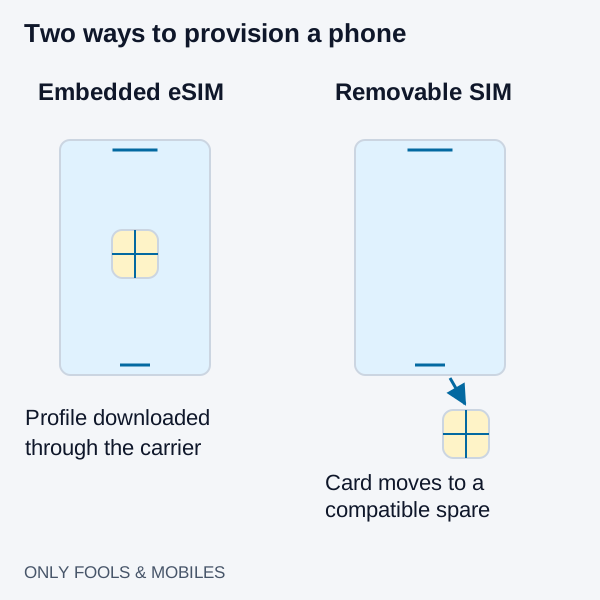
eSIM vs. Physical SIM Card: Carrier Switching, Roaming, and Theft Security
Compare eSIM and physical SIM for travel, broken-phone recovery and theft protection, with carrier-specific activation and roaming checks.
Read technical guide
How to Stop Apps Running in Background on Android (Battery Save Guide)
Find Android background battery drain, use Pixel or Galaxy controls, preserve messaging alerts and distinguish battery restrictions from background data.
Read technical guide