Amazon Renewed vs. Refurbished: Grading, Battery Health, and Warranty Compared
Compare Apple refurbished iOS devices with Amazon Renewed US battery, parts and cosmetic rules, then use a first-30-minute delivery checklist.
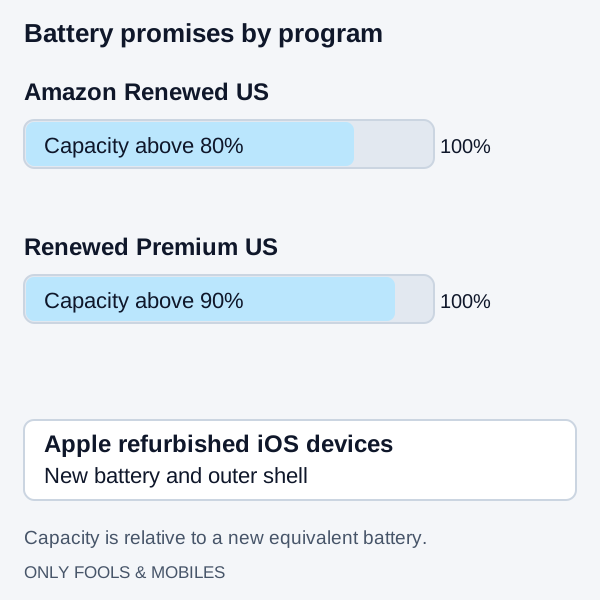
Amazon Renewed is a specific resale program; refurbished is a broader description. Compare the rules behind the label, not just the condition word. For US buyers, battery thresholds, replacement parts and the remedy for a faulty delivery deserve separate checks.
For a seller-independent inspection process, see our refurbished phone buying guide.
What each program promises
| Item | Apple Certified Refurbished iOS devices | Amazon Renewed US |
|---|---|---|
| Battery | New battery | Above 80% of new-equivalent capacity; above 90% for Premium |
| Enclosure | New outer shell | Condition depends on listed grade |
| Replacement parts | Genuine Apple parts as needed | US quality policy requires OEM components; Apple battery replacements must be new Apple batteries |
| Protection | One-year Apple limited warranty | Check the selected listing’s Renewed Guarantee and return terms |
These requirements come from Apple’s program page and Amazon’s US quality policy. Apple’s new-battery promise does not specify a guaranteed cycle-counter reading. Amazon’s minimum capacity is not a promise of a particular daily runtime.
Amazon’s public Renewed explanation describes a 90-day replacement or refund period. The US Renewed Premium policy specifies a 365-day Renewed Guarantee. Check the exact order and applicable exclusions before paying extra. A guarantee and a manufacturer’s limited warranty are different arrangements; retain the terms that apply to your purchase.
Standard phone grades and the separate Premium rule
Amazon’s US Appendix A contains a separate table for phones, smartwatches and tablets. Do not substitute the desktop-computer grading table.
| Phone grade | Display | Body |
|---|---|---|
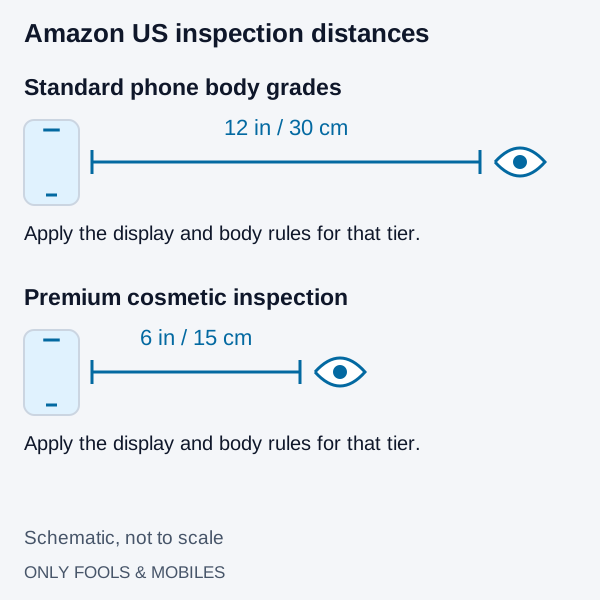
| Excellent | No cosmetic imperfections | Only a small number of very light micro-scratches, invisible at 12 inches / 30 cm |
| Good | No cosmetic imperfections | Light scratches must be invisible at that distance and imperceptible to touch |
| Acceptable | Small, light surface scratches may be present if invisible with the screen on; no cracks or major imperfections causing dead/stuck pixels | Visible scratches and up to three minor dents are permitted; no rear-glass cracks |
Camera lenses must have no cosmetic imperfections. These are Amazon’s US Excellent/Good/Acceptable phone-grade rules, not universal A/B/C grades. Premium has a stricter, separate rule: its US seller policy requires no visible cosmetic damage at 6 inches / 15 cm, with displays and camera lenses free of cosmetic imperfections. That Premium policy supersedes the general requirements. Read the specific tier rather than applying the 12-inch standard to Premium.
Battery and parts checks
Amazon’s Apple-specific appendix prohibits harvested or refurbished Apple batteries and requires new Apple batteries for replacements. An OEM-component rule should not be rewritten as permission to install any third-party part. Save the seller’s response if the delivered component history appears inconsistent with the program.
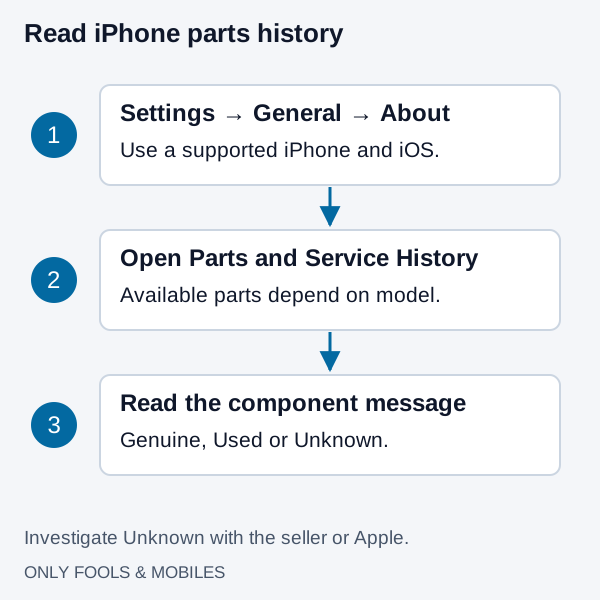
On supported iPhones, Parts and Service History is under Settings → General → About. It can show Genuine, Used, Unknown or other service messages. Available components vary by model. Unknown has several possible causes, so it is a reason to investigate rather than proof of one particular fault. Absence of an entry cannot authenticate every part.
A first-30-minute delivery checklist
Start with these delivery checks, then monitor runtime during ordinary use:
- First five minutes: Photograph packaging and damage, match the model to the order and verify setup is not blocked by the previous owner’s account.
- Next five: Compare screen and body condition with the chosen grade, record battery health or service messages where available and inspect parts history.
- Next ten: Test touch, buttons, speakers, microphone, each camera and charging. Do not put the phone in water: water resistance can diminish with wear.
- Final ten: Activate the intended plan, check calls, messages, Wi-Fi and mobile data. Verify carrier lock status. Preserve the return deadline and seller details.
Continue checking real runtime during the return period. A quick inspection cannot predict battery longevity or prove that a repaired enclosure retains its original seal. For a mismatch, report the observed symptom and the specific written promise rather than treating every warning as automatic entitlement to a particular remedy.
Related technical guides
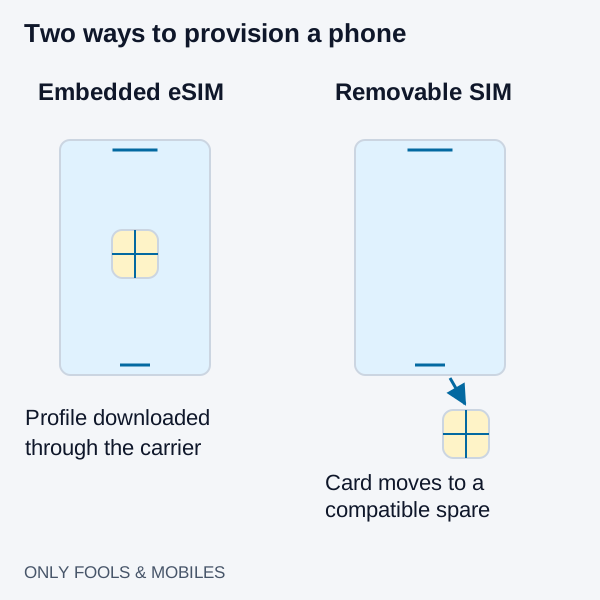
eSIM vs. Physical SIM Card: Carrier Switching, Roaming, and Theft Security
Compare eSIM and physical SIM for travel, broken-phone recovery and theft protection, with carrier-specific activation and roaming checks.
Read technical guide
How to Stop Apps Running in Background on Android (Battery Save Guide)
Find Android background battery drain, use Pixel or Galaxy controls, preserve messaging alerts and distinguish battery restrictions from background data.
Read technical guide
5G UW vs. 5G UC: mmWave, C-Band Frequency, and Battery Drain Explained
Understand Verizon 5G UW and T-Mobile 5G UC, mid-band versus mmWave coverage, and how iPhone 5G Auto changes network selection.
Read technical guide